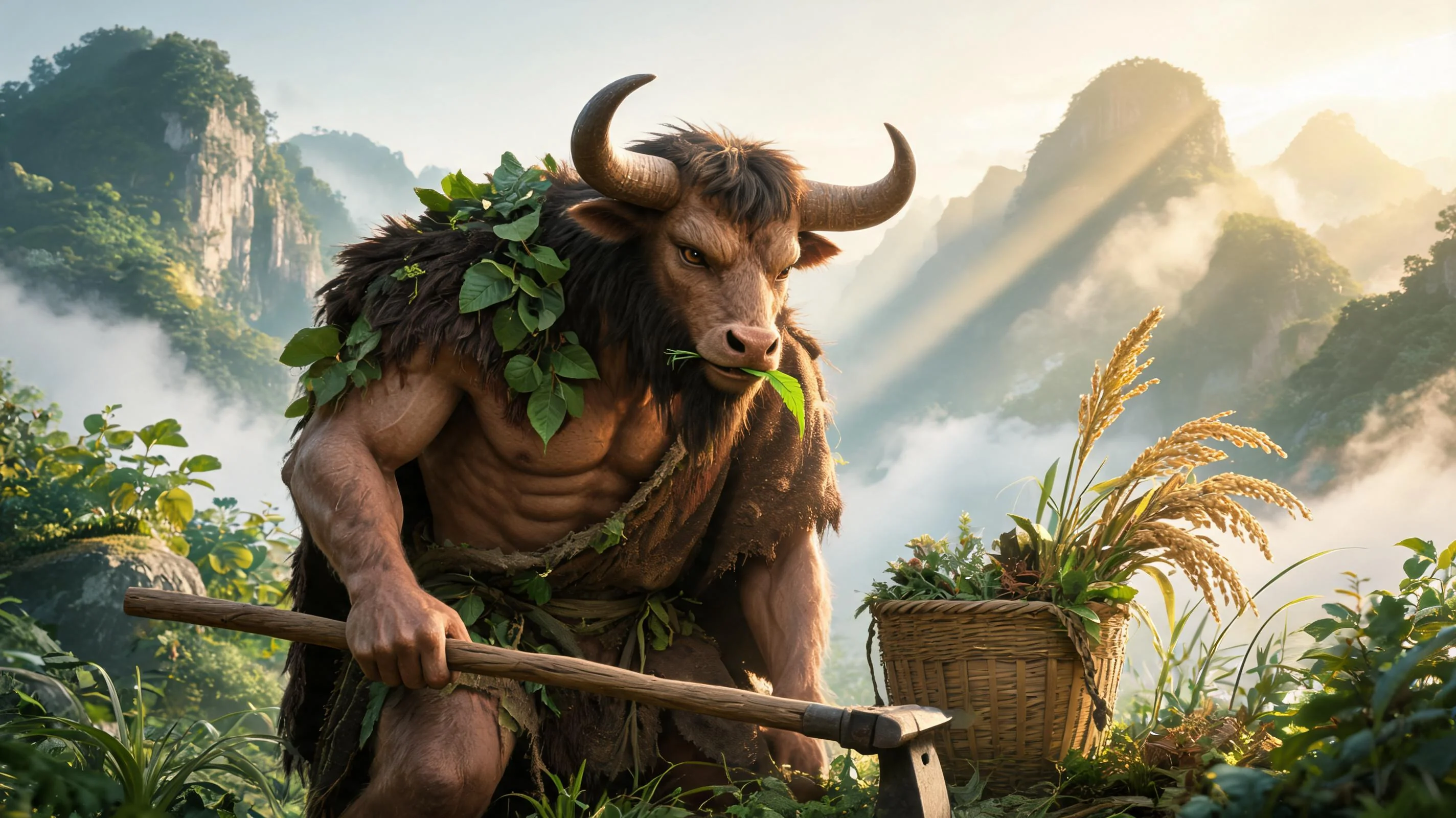
Shennong
神农氏 · 神農氏
Yandi Shennong: Ancestral Deity of Medicine and Agriculture
Divine Office
- Tasted hundreds of herbs to discern their medicinal properties and invented traditional medicine
- Invented the plough (leisi) and hoe (lei) to teach people farming and cultivation of the Five Grains
- Established markets to facilitate exchange of goods
- Protecting agriculture, medicine, and all crafts
Origin & Legend
Shennong, also known as Yandi (the Fiery Emperor), bore the Jiang surname and possessed a human body with an ox head; he ranked among the Three Sovereigns. In remote antiquity, people subsisted on wild plants and hunted game, yet rampant disease plagued them. To alleviate suffering, Shennong personally tasted hundreds of herbs—enduring seventy poisonings in a single day—until he distinguished edible plants from medicinal remedies, thereby founding Chinese medical science and earning veneration as the Ancestral Deity of Medicine. He also carved wood into the plough (si) and bent wood into the hoe (lei), instructing humanity in cultivating the Five Grains and ushering in the agrarian age from earlier hunting-and-gathering societies. Furthermore, he instituted markets—holding trade at midday ('ri zhong wei shi')—to enable equitable exchange of goods. The Yan Emperor’s tribe later allied with the Yellow Emperor’s tribe at Zhuolu, forming the shared ancestral lineage of the Huaxia people; thus, the Chinese refer to themselves as 'descendants of Yan and Huang'. Grand sacrificial ceremonies honouring Yandi continue to this day in places such as Suizhou and Yanling, where farmers and herbalists alike revere him as their founding master.
 Warding Off Evil
 Children & Marriage
 Safety & Blessing
 Children & Marriage
 Children & Marriage
 Safety & Blessing
 Safety & Blessing
 Safety & Blessing