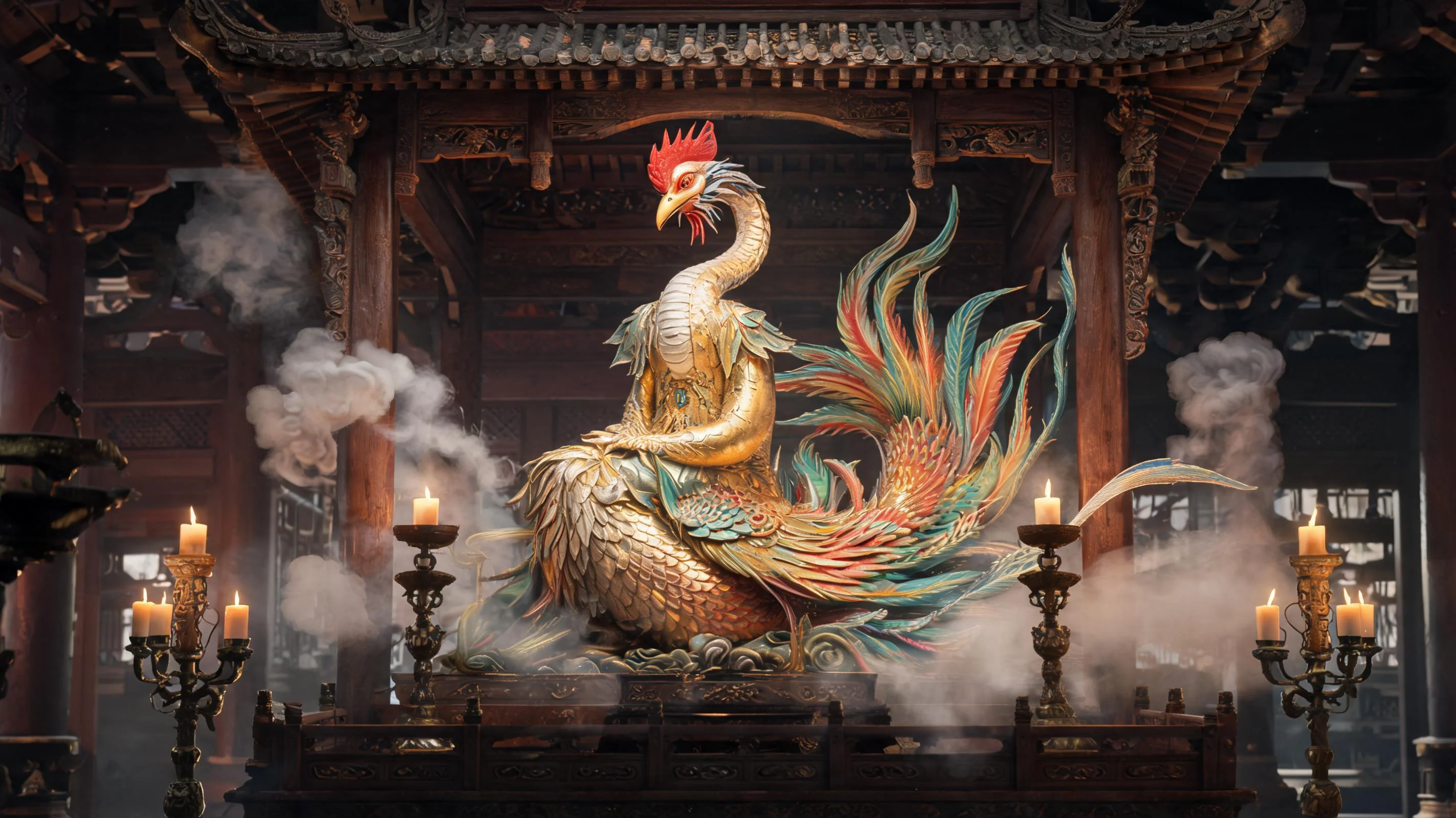
Fenghuang (Chinese Phoenix)
凤凰 · 鳳凰
King of All Birds and One of the Four Divine Beasts
Divine Office
- Ushering in universal peace and prosperity
- Embodying the virtues of virtue, righteousness, benevolence, and trustworthiness
- Overseeing all avian creatures
- Guarding auspiciousness, harmony, and tranquillity
Origin & Legend
The Classic of Mountains and Seas: The Classic of the Southern Mountains records that on Mount Danxue dwells a bird resembling a chicken, adorned with five-coloured plumage and intricate patterns, named the Fenghuang—'its appearance signifies great peace throughout the realm.' The characters inscribed upon its head signify virtue, those upon its wings righteousness, those upon its back propriety, those upon its breast benevolence, and those upon its belly trustworthiness; thus its entire body embodies the Five Virtues. In ancient Chinese belief, the Fenghuang reigned as sovereign over all birds, alighting exclusively upon paulownia trees, feeding solely on bamboo seeds, and drinking only sweet spring water. The legendary tale of Xiao Shi and Nong Yu, who lured the Fenghuang with their xiao flutes, and the auspicious omen of the Fenghuang’s cry at Mount Qi during the reign of King Wen of Zhou, both heralded eras of enlightened rule and flourishing civilisation. Paired with the dragon—the Fenghuang and dragon together form the iconic 'dragon-and-phoenix auspicious motif'—this imagery adorns imperial palaces and ceremonial robes, standing among the highest symbols of Chinese auspicious culture.
 Warding Off Evil
 Children & Marriage
 Safety & Blessing
 Children & Marriage
 Health & Averting Calamity
 Children & Marriage
 Safety & Blessing
 Safety & Blessing