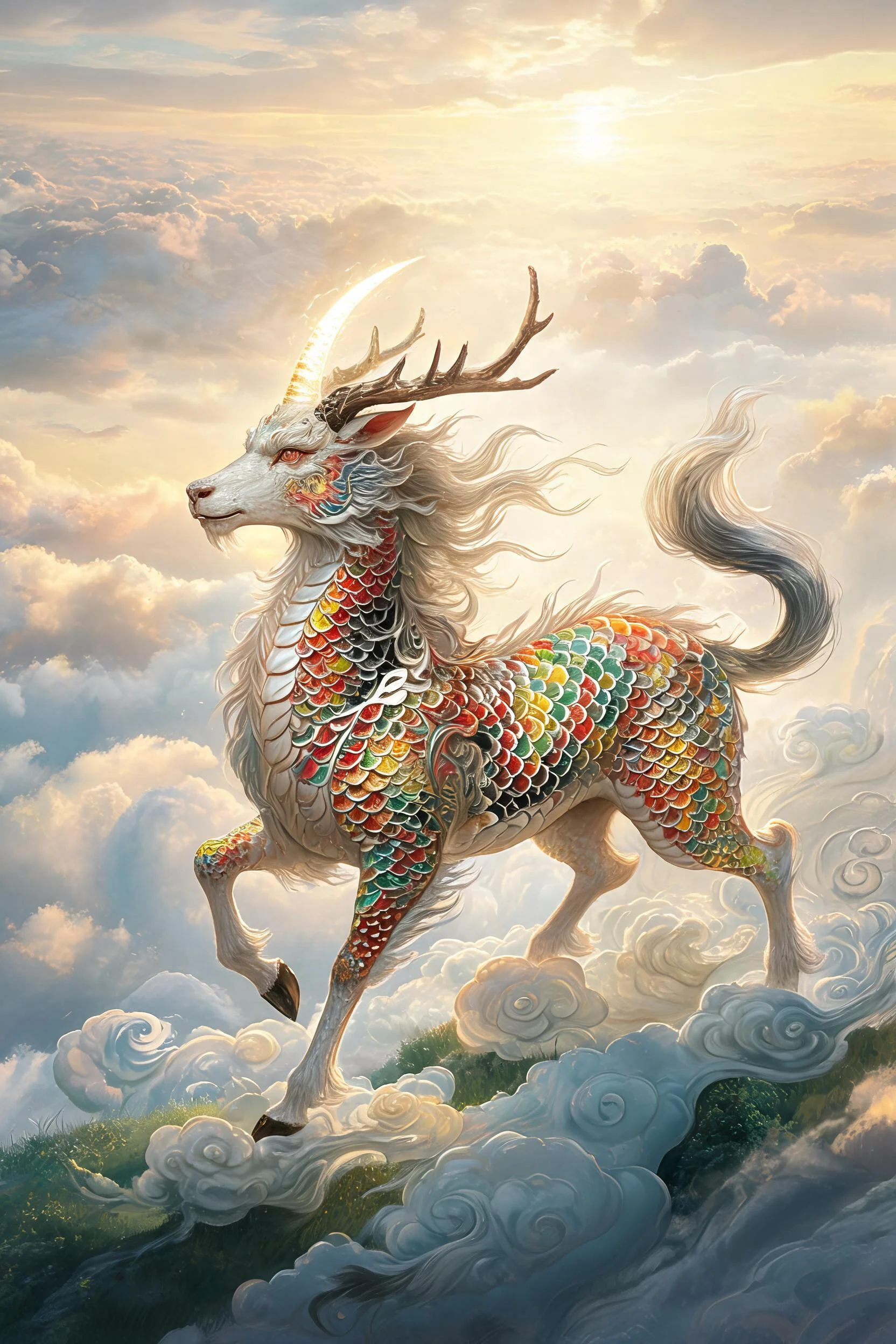
AI-generated likeness
Ancient Mythology
Qilin
麒麟 · 麒麟
The Benevolent Beast; Foremost of the Four Divine Beasts
Divine Office
- Manifesting the advent of a sage ruler and an era of great peace
- Protecting safety and bestowing blessings
- Delivering children to childless couples (the Qilin Delivering a Son)
- Symbolising benevolence and virtue
Origin & Legend
The qilin is one of the Four Divine Beasts enumerated in the Confucian classic Liji (Book of Rites), specifically in the chapter 'Liyun' ('The Operation of Rites'). It possesses the body of a deer, the tail of an ox, the hooves of a wolf, and a single horn whose tip bears soft flesh. Embodying humaneness and righteousness, it treads not upon living insects, breaks not living grass, drinks not from ponds, and enters not into traps—appearing solely in times governed by benevolent virtue. Legend holds that Confucius composed the Spring and Autumn Annals, concluding his work upon hearing of the capture of a qilin during Duke Ai of Lu’s western hunt—an event that moved him to lament the imminent exhaustion of the Dao, as even this paragon of benevolence had fallen into human hands. Subsequently, the qilin became a potent symbol of auspicious peace and moral excellence: Han-dynasty pictorial stones frequently depict it alongside the phoenix and the white tiger; the folk custom of 'The Qilin Delivering a Son' elevated it to the status of a tutelary deity invoked for fertility and blessings; and its image commonly adorns temple spirit walls and gate lintels in colourful murals.
 Warding Off Evil
 Children & Marriage
 Safety & Blessing
 Children & Marriage
 Health & Averting Calamity
 Children & Marriage
 Safety & Blessing
 Safety & Blessing