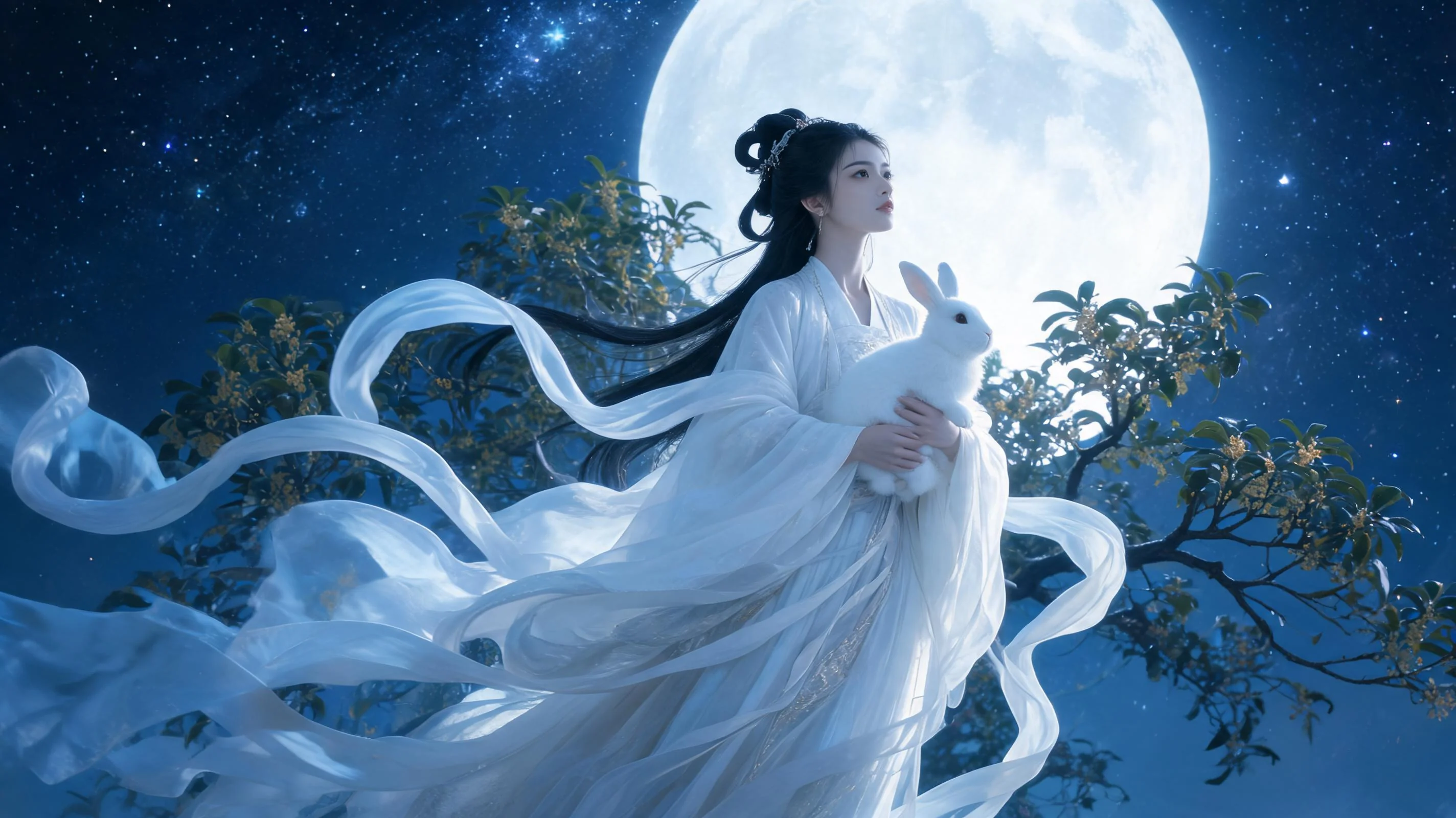
Chang'e
嫦娥 · 嫦娥
Celestial Maiden of the Moon Palace and Goddess of the Moonward Ascension
Divine Office
- Governing the moonlight’s pure radiance from the Moon Palace
- Blessing harmonious marriages and auspicious unions symbolised by blossoms and the full moon
- Ensuring family reunions and household peace and safety
- Receiving the Mid-Autumn Festival moon-worship offerings made by mortals
Origin & Legend
Chang'e—also known in early texts as Heng'e—is the most renowned and beautiful celestial maiden of the Moon Palace in ancient Chinese mythology. Legend holds that she was the wife of Hou Yi, the heroic archer who shot down nine of the ten suns. After obtaining the elixir of immortality from the Queen Mother of the West, Hou Yi entrusted it to Chang'e for safekeeping. When the treacherous apprentice Feng Meng attempted to seize the elixir while Hou Yi was away, Chang'e, in desperation, swallowed it and immediately ascended to the moon, where she took up solitary residence in the Palatial Cold Palace, attended only by the Jade Rabbit. 'Chang'e must regret stealing the divine elixir—night after night, her heart aches beneath the boundless azure sea and vaulted heavens,' wrote the Tang poet Li Shangyin, capturing her profound solitude and melancholy. Grieving Hou Yi, stricken with longing, set up an incense altar on the night of the full moon to worship her from afar—giving rise to the folk custom of moon worship during the Mid-Autumn Festival. Later traditions tell of Wu Gang endlessly felling the osmanthus tree and the Jade Rabbit pounding herbs in the Moon Palace. On Mid-Autumn night, families gather to admire the full moon and share mooncakes—a ritual imbued with heartfelt wishes for reunion, all entrusted to Chang'e.
 Warding Off Evil
 Children & Marriage
 Safety & Blessing
 Children & Marriage
 Health & Averting Calamity
 Safety & Blessing
 Safety & Blessing
 Safety & Blessing