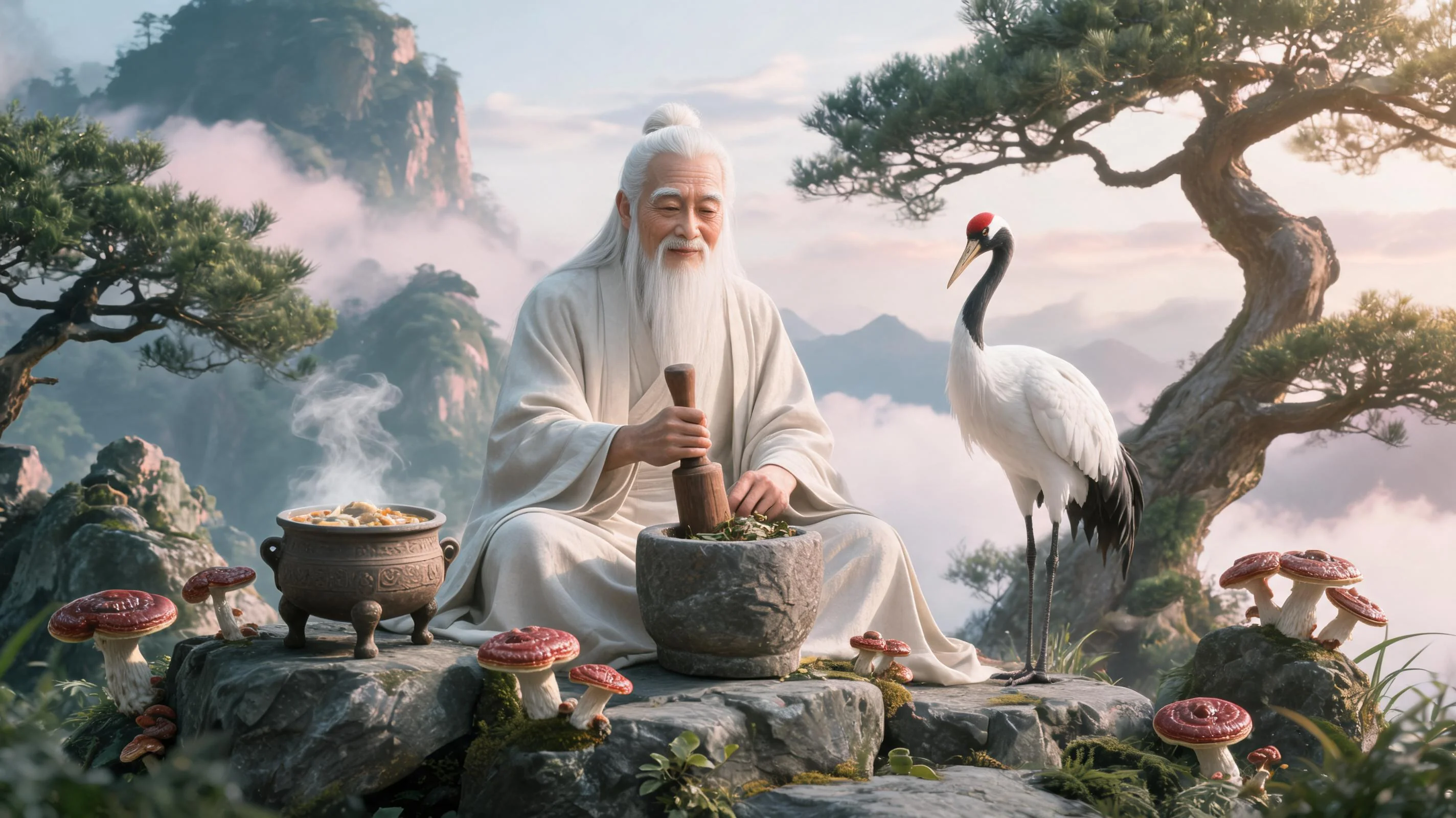
Peng Zu
彭祖 · 彭祖
Primordial Deity of Longevity and Health Cultivation
Divine Office
- Mastering techniques for longevity and life extension
- Teaching health cultivation methods such as qigong-guided breathing and breath regulation
- Inventing the medicinal pheasant stew for dietary therapy
- Protecting the health and ensuring long, blessed lives for the elderly
Origin & Legend
Peng Zu, whose surname was Jian and given name Keng, was traditionally believed to be the great-great-grandson of Zhuan Xu, and one of the most renowned deities of longevity in antiquity. Legend holds that he lived through the Xia and Shang dynasties, attaining the extraordinary lifespan of eight hundred years—hence his title Peng Zu. He mastered health cultivation, specializing in qigong-guided breathing, breath regulation, and qi absorption while abstaining from grains, advocating a philosophy centered on tranquility, emptiness, and nourishing the spirit—the foundational principles of Daoist health practices. He was also an accomplished culinary master: his specially prepared pheasant stew so delighted Emperor Yao that Yao enfeoffed him in Pengcheng (modern-day Xuzhou), earning Peng Zu veneration among chefs as the ancestral patron of dietary therapy. In folk belief, Peng Zu is worshipped as the God of Longevity; during festivals and birthday celebrations for elders, people commonly wish 'May your longevity rival Peng Zu’s!' Ruins of the Peng Zu Well and Peng Zu Temple in Xuzhou remain pilgrimage sites where devotees pray for robust health and enduring longevity—a tradition sustained to this day.
 Warding Off Evil
 Children & Marriage
 Safety & Blessing
 Children & Marriage
 Health & Averting Calamity
 Children & Marriage
 Safety & Blessing
 Safety & Blessing