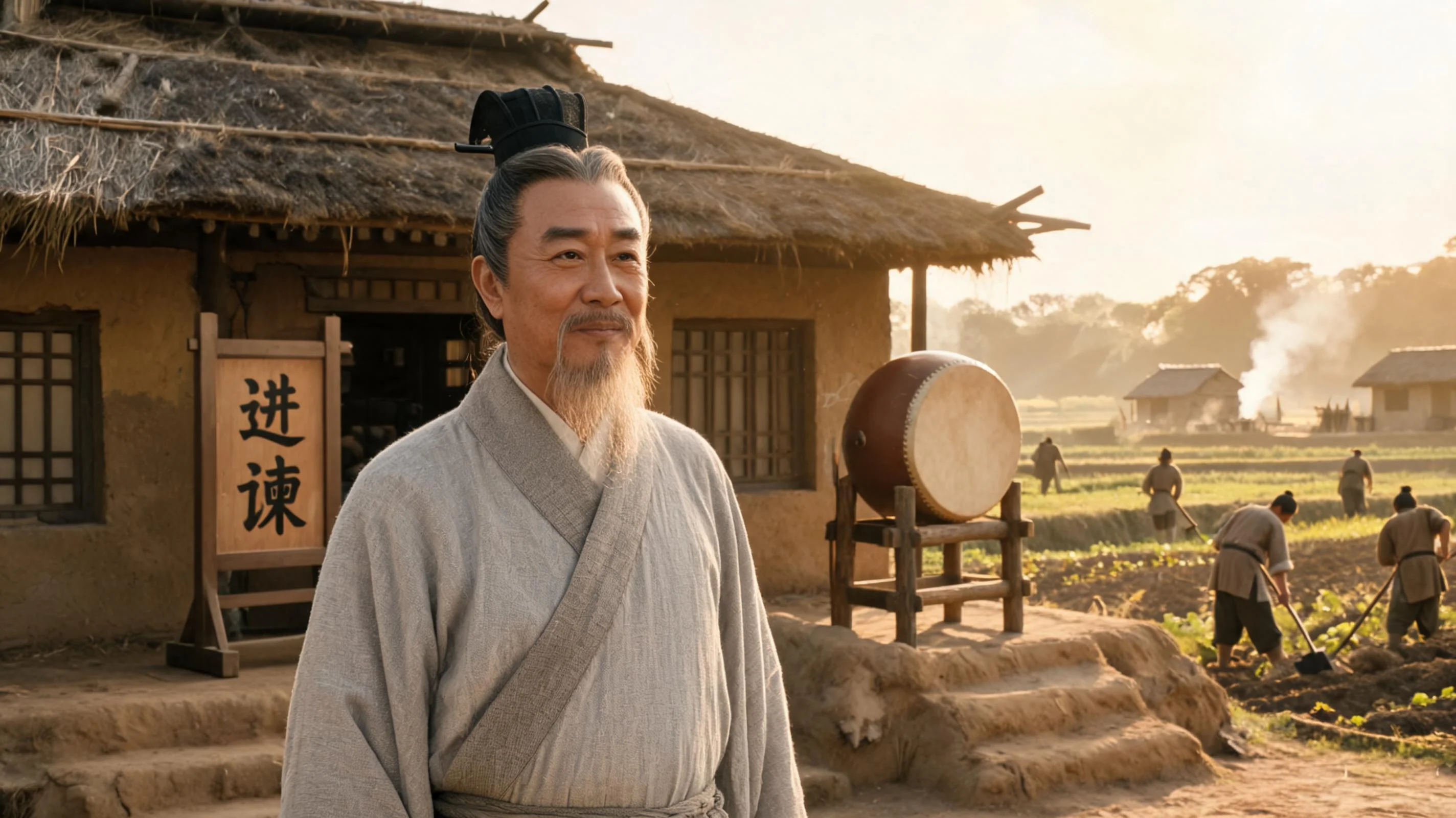
Emperor Yao
尧帝 · 堯帝
Tang Yao, the Benevolent and Virtuous Sage Sovereign
Divine Office
- Governing with benevolence and virtue to achieve universal harmony
- Instituting the Drum of Remonstrance and the Pillar of Criticism to solicit counsel from the people
- Commanding the archer Yi to shoot down nine of the ten suns and thereby deliver the people from calamity
- Abdicating the throne to Shun, thus inaugurating the tradition of meritocratic succession
Origin & Legend
Emperor Yao, personal name Fangxun and clan name Taotang, was one of the Five August Emperors and stands as the quintessential paragon of benevolent and virtuous rulership in Chinese history. Rather than passing the throne to his own son, he chose humility over hereditary privilege: his palace featured untrimmed thatch roofs and uncarved wooden rafters; he subsisted on coarse millet gruel and wild-vegetable soup, sharing both hardship and joy with his people. Legend recounts that when ten suns rose simultaneously, scorching the earth, Yao dispatched the archer Yi to shoot down nine of them, rescuing the populace from devastation. He also commissioned Xi and He to observe celestial phenomena and formulate a precise calendar—the first official agricultural almanac—thereby ensuring orderly farming cycles. To foster open governance, he erected the Drum of Remonstrance, inviting citizens to beat it when offering advice, and the Pillar of Criticism, where grievances could be inscribed publicly—a pioneering step toward participatory rule. In his later years, seeking a worthy successor, Yao traveled far and wide to identify talent, ultimately abdicating the throne to Shun, a man of exceptional virtue and ability, rather than appointing his own heir. This act enshrined the principle of 'the realm held in common' (tianxia weigong) as the highest ideal of Chinese political civilization. Confucius extolled him thus: 'Only Heaven is vast; only Yao emulated its greatness.'
 Warding Off Evil
 Children & Marriage
 Safety & Blessing
 Children & Marriage
 Health & Averting Calamity
 Children & Marriage
 Safety & Blessing
 Safety & Blessing