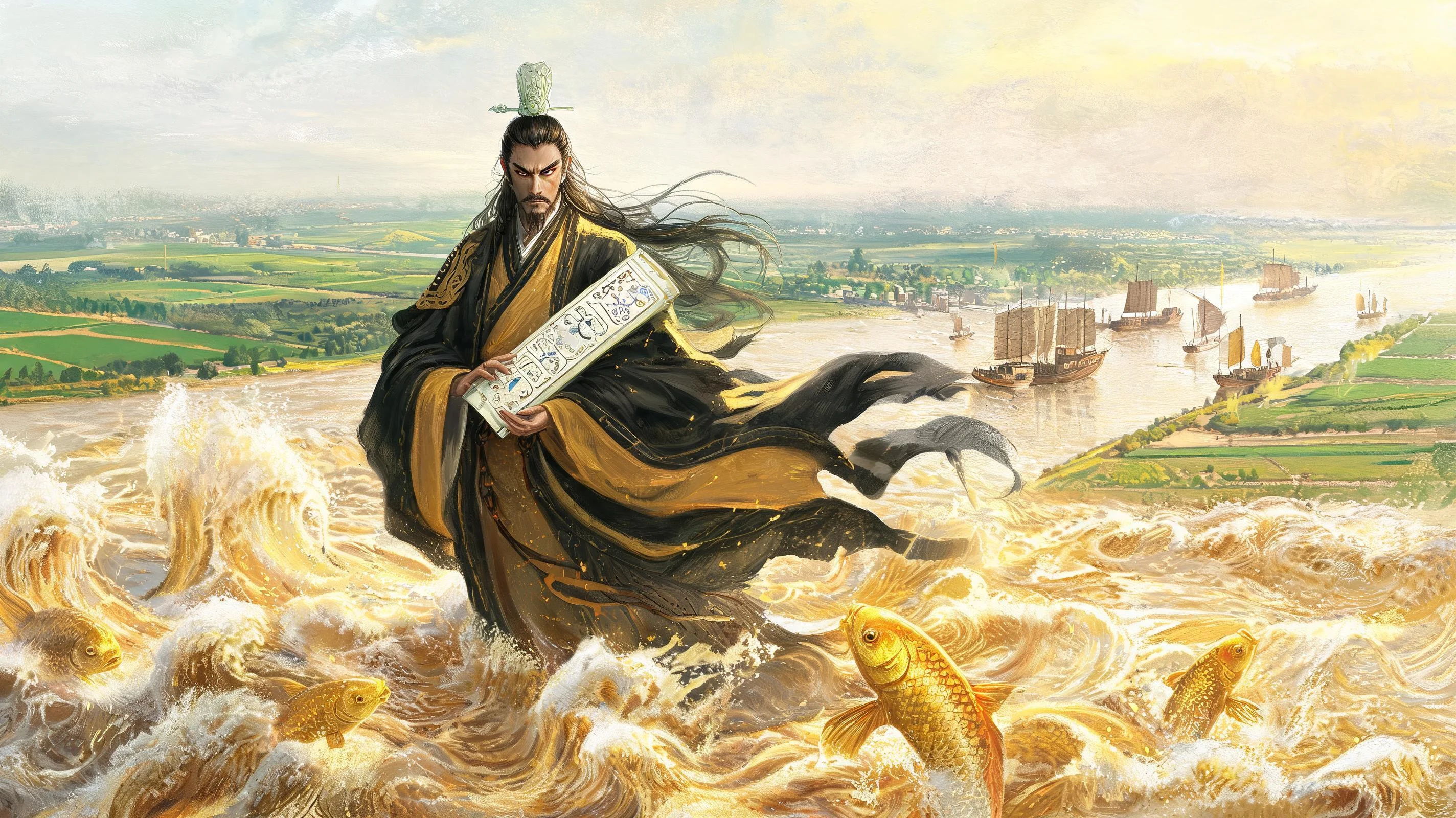
God of the Yellow River
河渎之神 · 河瀆之神
Lingyuan Wang of the He Du (Royal Lord of the Spiritual Source, Deity of the Yellow River)
Divine Office
- Governance of the Yellow River’s hydrological affairs and safeguarding of its dikes against flooding
- Regulating river water to irrigate the fertile plains of Zhongyuan
- Protecting the safety of grain transport routes and ferry crossings
- Receiving state-sponsored sacrifices in imperial ritual canon
Origin & Legend
He Du Zhi Shen is the officially sanctioned, exalted deity of the Yellow River enshrined in state ritual, distinguished from the legendary He Bo Feng Yi of early folklore and classical texts; his divine status is solemn and august. Since the 'Book of Rites' established rites for the Four Great Rivers, emperors across successive dynasties dispatched officials annually to perform sacrifices to the He Du. In the Han dynasty, a temple dedicated to the He Du was erected at Linjin; the Tang court conferred upon him the title Lingyuan Gong (Duke of the Spiritual Source); the Song court elevated him to Lingyuan Wang (Royal Lord of the Spiritual Source); and the Yuan court added the honorific Hongji (Vastly Beneficent) to his title, making him Lingyuan Hongji Wang. During the Ming and Qing dynasties—when Yellow River management directly affected the stability of the realm—ritual observances reached unprecedented heights: Emperor Yongzheng commissioned the construction of Jiaying Temple in Wuzhi County, Henan, a unique complex integrating palace, temple, and administrative yamen functions, serving as the supreme ceremonial and administrative center for river governance and worship. The sacrifices to He Du embody the agrarian civilization’s dual reverence and awe toward the Mother River: praying for placid, predictable flows while fearing catastrophic course changes. Jiaying Temple preserves steles inscribed by generations of river engineers, bearing silent witness to the millennia-long symbiosis between the great river and the Chinese nation.
 Safety & Blessing
 Safety & Blessing
 Safety & Blessing
 Safety & Blessing
 Safety & Blessing
 Safety & Blessing
 Safety & Blessing
 Safety & Blessing