
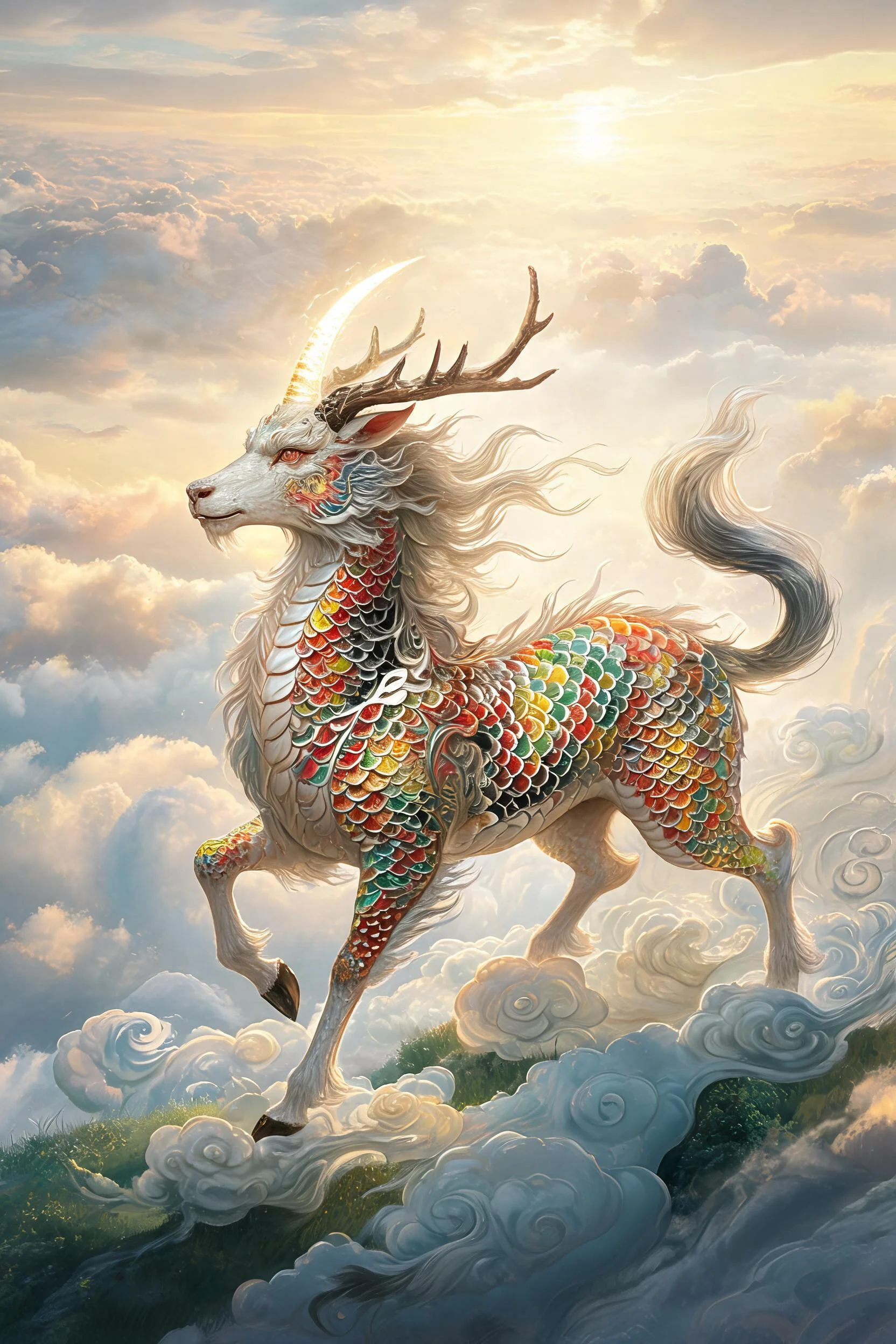
Bai Ze
白泽 · 白澤
Auspicious Beast of Universal Knowledge
Divine Office
- Understanding the nature of all things under heaven
- Identifying ghosts, deities, and spirits throughout the world
- Manifesting the virtuous governance of sage rulers
- Protecting peace and dispelling disease
Origin & Legend
According to the *Yunji Qiqian* (Seven Bamboo Tablets of the Cloudy Satchel), citing the *Xuan Yuan Ben Ji* (Annals of Xuanyuan), when the Yellow Emperor conducted an inspection tour to the East Sea, he met the divine beast Bai Ze, which could speak and possessed comprehensive knowledge of all phenomena in the universe. It knew the names, forms, and habits of precisely 11,520 kinds of ghosts, deities, and spirits, and instructed the emperor on methods to ward them off. Thereupon, the Yellow Emperor ordered court artists to sketch their appearances and compiled them into the *Bai Ze Tu*, disseminating it throughout the realm. In later centuries, common households hung copies of the *Bai Ze Tu* in their homes to safeguard dwellings and expel malevolent forces—legends held that spirits and monsters would flee upon seeing its images. Thus, Bai Ze became a symbol of erudition and auspiciousness: Tang and Song dynasty imperial processions featured banners bearing Bai Ze’s image, and palace gates were adorned with murals of Bai Ze as talismans for exorcism and domestic tranquillity.
 Warding Off Evil
 Children & Marriage
 Safety & Blessing
 Children & Marriage
 Health & Averting Calamity
 Children & Marriage
 Safety & Blessing
 Safety & Blessing