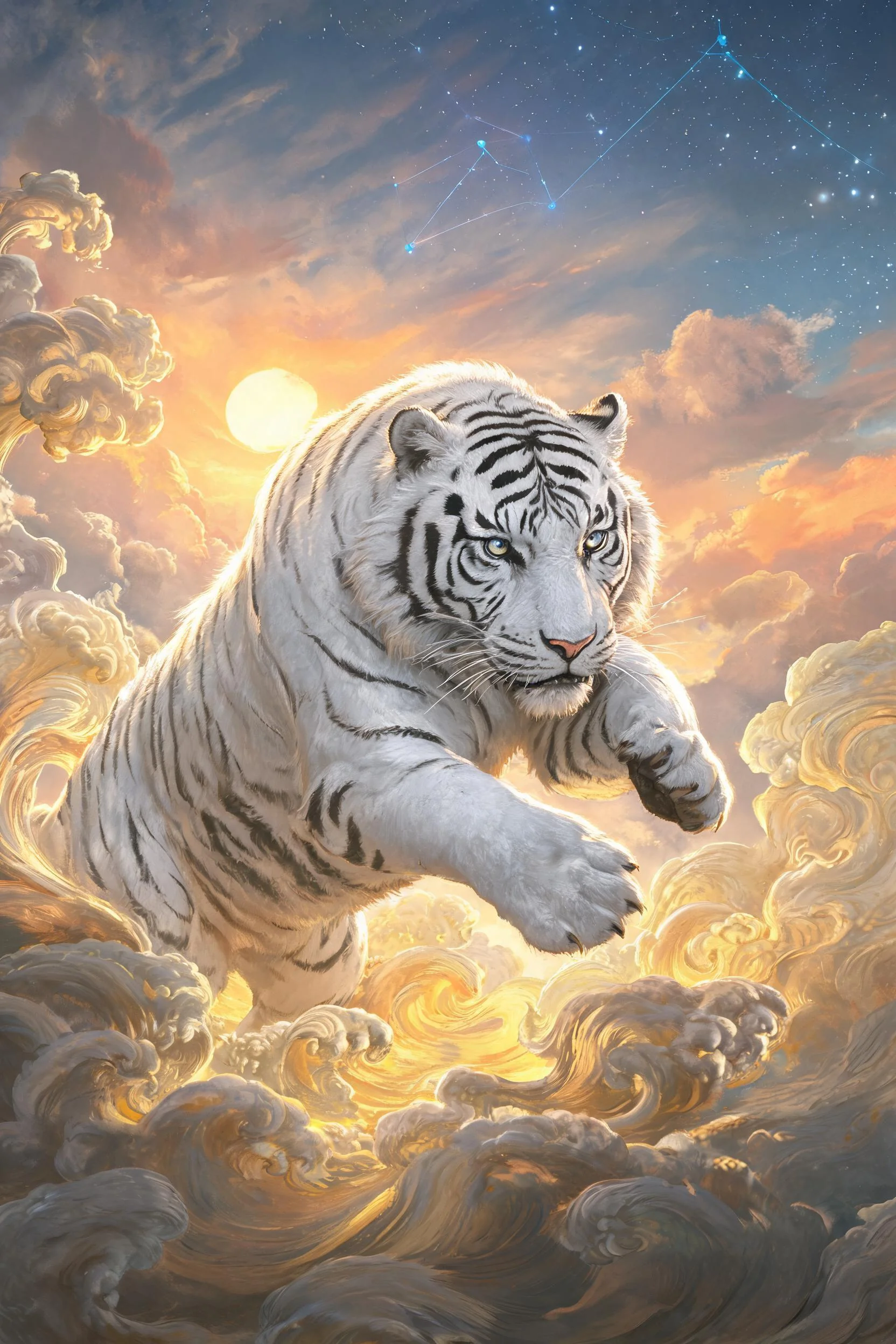
AI-generated likeness
Ancient Mythology
White Tiger
白虎 · 白虎
Deity of the Seven Lunar Mansions of the Western White Tiger
Divine Office
- Guardian of the West
- Master of Autumn and of Punishment and Warfare
- Warder-off of Malevolent Spirits and Protector of Dwellings
- Sovereign of the Seven Western Mansions—Kui, Lou, Wei, Mao, Bi, Zi, and Shen
Origin & Legend
Baihu (White Tiger) is one of the Four Celestial Symbols, formed by the asterism of the seven western lunar mansions—Kui, Lou, Wei, Mao, Bi, Zi, and Shen. It governs Autumn, corresponds to the Metal element, and bears the colour white. As the king of all beasts, the tiger features prominently in classical texts: the Shanhai Jing (Classic of Mountains and Seas) records that divine tigers devour ghosts and demons. Ancient Chinese believed that the appearance of the White Tiger signified the sovereign’s virtuous governance and heralded an era of peace and auspicious harmony. During the Han dynasty, the White Tiger’s image was widely deployed on roof-tile endpieces (wa dang), pictorial stones, and tomb gates to guard burial sites and repel malign influences. The influential Confucian compendium Baihu Tongyi (Comprehensive Discussions from the White Tiger Pavilion) derived its title from the imperial lecture hall—the White Tiger Pavilion—where scholars convened to debate canonical texts. Endowed with both the awe-inspiring might of a god of warfare and the solemn authority of a celestial guardian, the White Tiger stands as the divine protector of the West.
 Warding Off Evil
 Children & Marriage
 Safety & Blessing
 Children & Marriage
 Health & Averting Calamity
 Children & Marriage
 Safety & Blessing
 Safety & Blessing