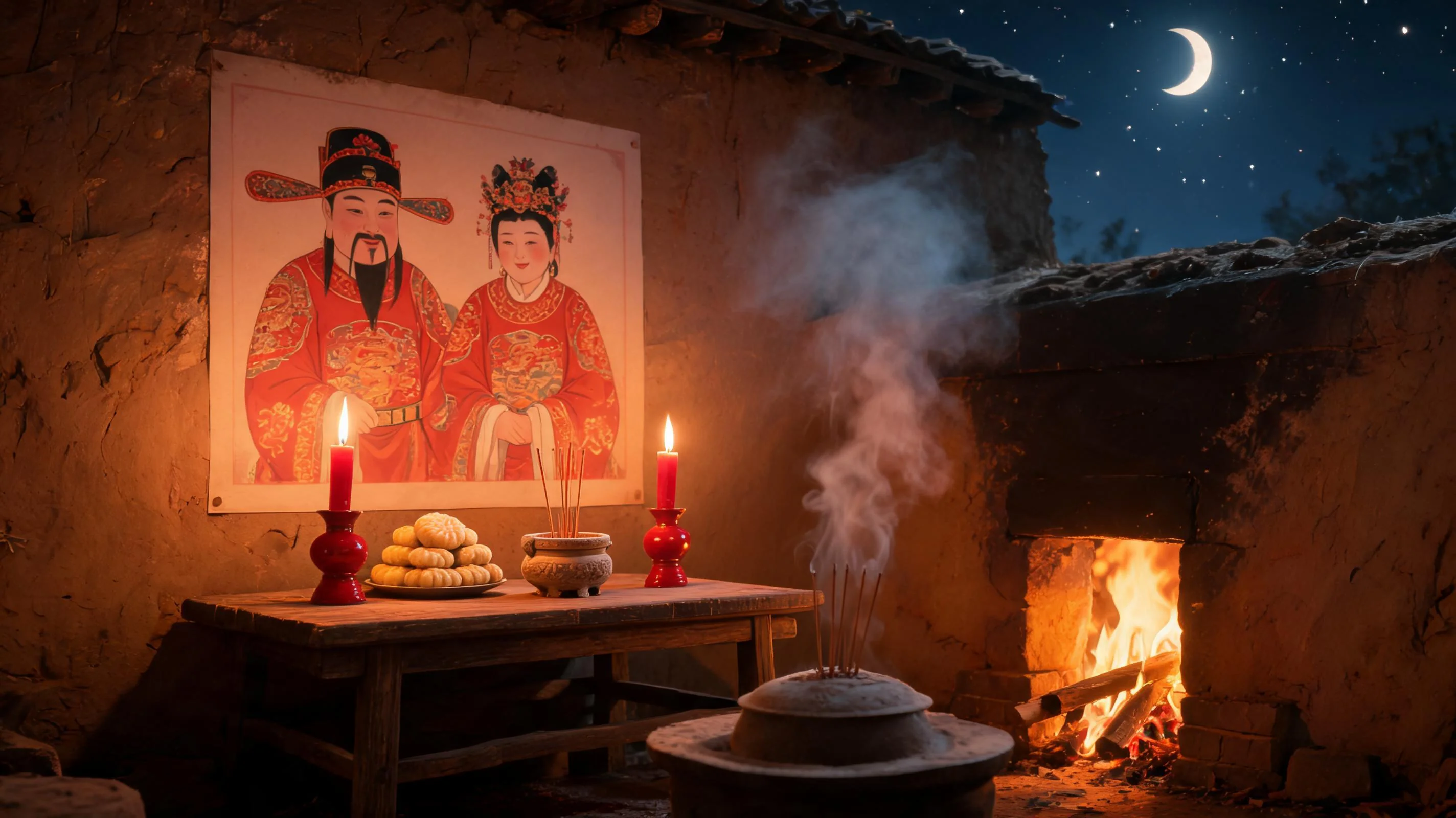
Kitchen God (Zao Shen)
灶君 · 灶君
Dongchu Siming Jiuling Yuanwang Dingfu Shenjun (Lord of the Eastern Kitchen, Director of Fate, Primordial King of the Nine Spirits, Divine Lord Who Determines Blessings)
Divine Office
- Resides at each household’s kitchen stove to observe and record the family’s virtuous and wrongful deeds
- Ascends to Heaven on the Little New Year to report human merits and transgressions and determine fate and blessings
- Safeguards the safety of food and drink and ensures the hearth fire burns brightly and steadily
- Protects the health and sustenance of all family members, young and old
Origin & Legend
Belief in the Kitchen God originates from the ancient pre-Qin ritual of stove worship; the Rites of Zhou already lists the Stove God among the Five Household Deities. By the Han dynasty, the deity had become personified: legend holds that he regularly ascends to Heaven on the last day of each lunar month to report people’s sins, scrutinising every member of the household—hence the necessity of reverent offerings during the stove-worshipping rite. The Jin-dynasty Daoist master Ge Hong, in his Baopuzi, states that the Kitchen God reports human transgressions monthly, with grave offences resulting in the deduction of years from one’s lifespan. From the Song dynasty onward, the custom solidified of worshipping the Kitchen God on the 24th day of the twelfth lunar month, offering sticky malt sugar to seal his mouth and prevent unfavourable reports—thus encouraging him to speak only of good deeds before Heaven and return bearing auspicious blessings. His ceremonial welcome back into the household on Chinese New Year’s Eve constitutes a vital element of the annual cycle, embodying the Chinese people’s self-regulation rooted in familial ethics.
 Wealth
 Safety & Blessing
 Wealth
 Safety & Blessing
 Studies & Exams
 Wealth
 Children & Marriage
 Wealth