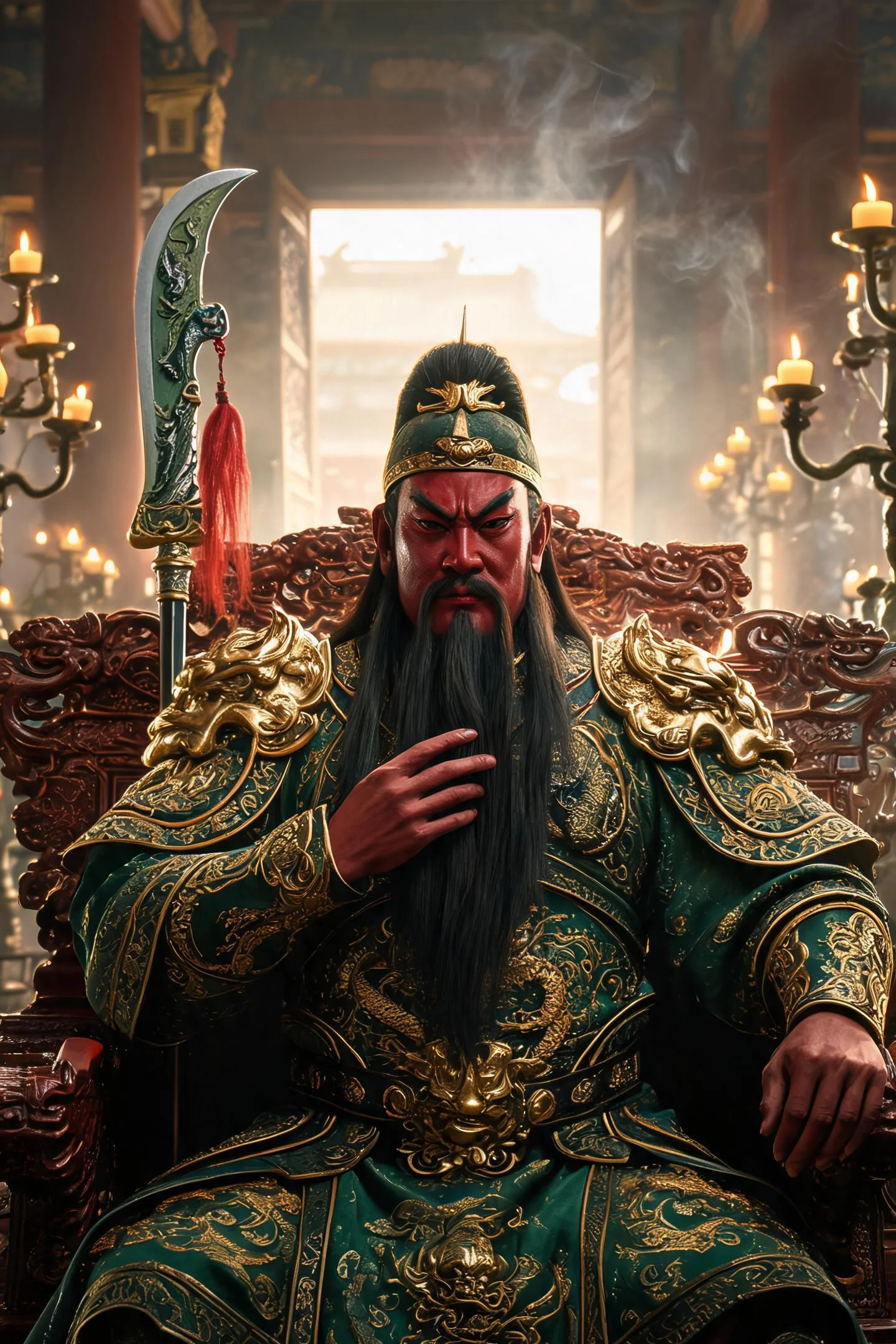
AI-generated likeness
Folk Deities
Lord Guan (Guandi)
关圣帝君 · 關聖帝君
Celestial Venerable Lord Guan, Emperor of Subduing Demons Throughout the Three Realms, Whose Divine Might Resounds Far and Wide
Divine Office
- Safeguarding merchants’ honest and ethical business practices and attracting wealth and prosperity—foremost among the Martial Deities of Wealth
- Upholding loyalty and righteousness as a divine protector, blessing sworn brotherhood, mutual aid among martial communities, and chivalrous solidarity
- Exorcising malevolent spirits and subduing demons, pacifying dwellings and stabilising the state, thereby protecting localities and ensuring public peace and security
- Overseeing fate and official emolument, bestowing blessings upon scholarly success in imperial examinations and professional achievement
Origin & Legend
Guan Yu, styled Yunchang, was a native of Jiezhou in Hedong Commandery during the late Eastern Han dynasty. Renowned for his unwavering loyalty, moral integrity, and martial valour, he met his end at Mai Cheng and was buried in Dangyang. Beginning in the Song dynasty, successive imperial courts conferred ever-higher posthumous titles upon him—from Marquis to King, then to Emperor; in the Wanli reign of the Ming dynasty he was honoured as Emperor of Subduing Demons Throughout the Three Realms, and in the early Qing dynasty he received the full title Loyal, Righteous, Divine, Valiant, Spiritually Protective, Benevolent, and Courageous Emperor Guan. Confucianism venerates him as the Martial Sage; Buddhism enshrines him as a guardian dharmapāla (Dharma protector); Daoism honours him as the Demon-Subduing Emperor; and merchants, inspired by his steadfast commitment to trustworthiness and fidelity, revere him as the pre-eminent Martial Deity of Wealth. The Guan Di Temple in Jiezhou, Shanxi—the ancestral temple of all Guandi temples worldwide—served as the spiritual heartland from which Guandi worship spread globally through the migrations of Shanxi merchants and Fujian and Guangdong traders.
 Safety & Blessing
 Wealth
 Safety & Blessing
 Studies & Exams
 Wealth
 Children & Marriage
 Wealth
 Safety & Blessing