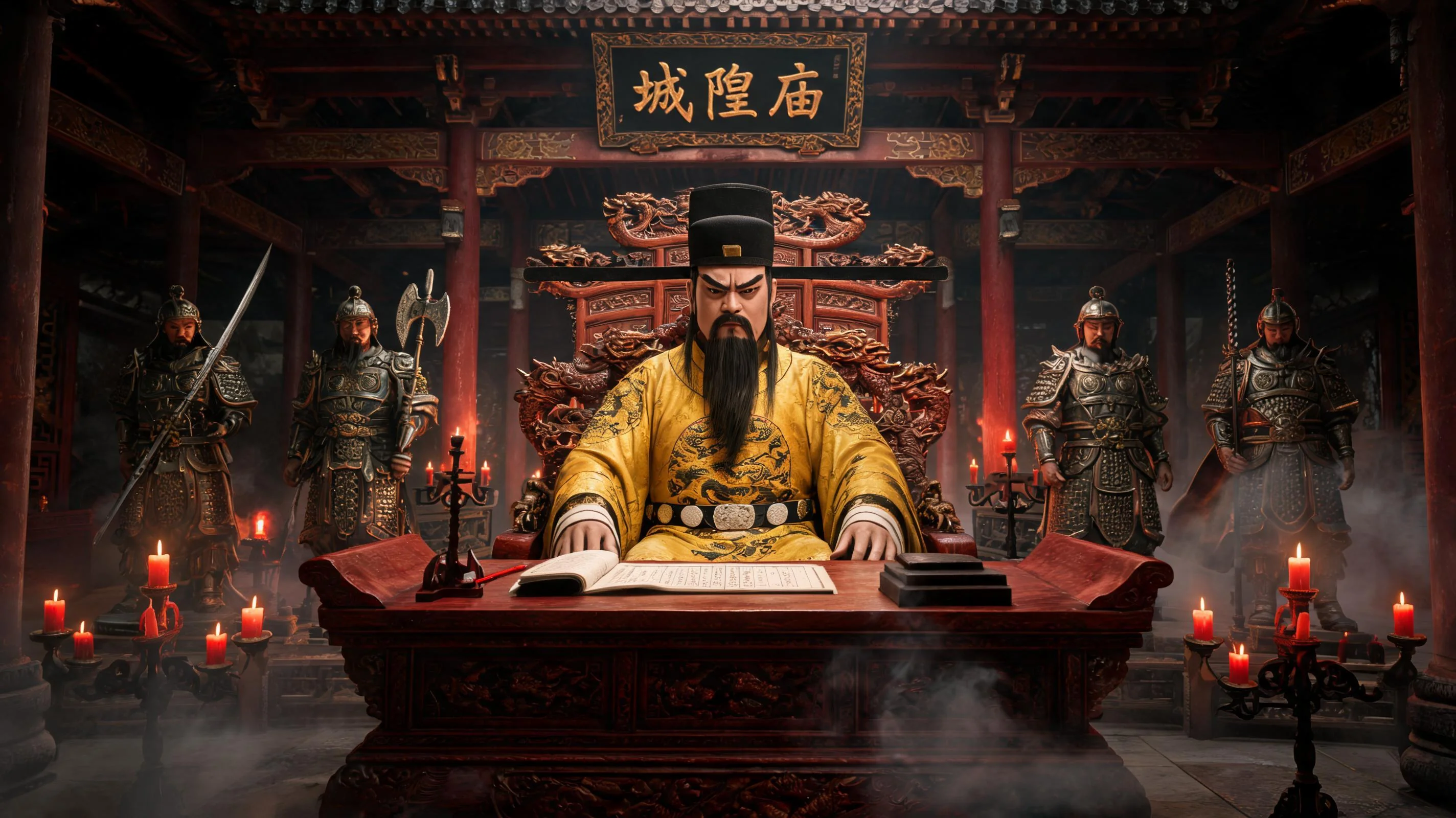
City God (Chenghuang)
城隍爷 · 城隍爺
His Venerable Majesty Fude Dawang, the Reverend and Responsive Celestial Sovereign Chenghuang Laoye
Divine Office
- Guarding the city walls and ensuring peace and safety for the local populace
- Overseeing both the mortal and spirit realms, rewarding virtue and punishing vice, and administering the registers of the netherworld
- Adjudicating wronged spirits, upholding justice, and mediating disputes
- Regulating wind and rain to ensure bountiful harvests in agriculture and sericulture
Origin & Legend
The Chenghuang cult originated in the Zhou-dynasty Ba La (Eight Sacrificial Deities) rites and the worship of Shuiyong, the god of waterways and ditches; the term 'Chenghuang' literally means 'city wall' and 'protective moat'. The earliest recorded Chenghuang temple dates to the Three Kingdoms period in the Wu region. By the Tang dynasty, Chenghuang veneration had spread widely across southern China; during the Song dynasty, imperial authorities formally incorporated Chenghuang sacrifices into the state ritual canon. In the Hongwu reign of the Ming dynasty, Emperor Taizu instituted a comprehensive system of Chenghuang enfeoffments, ranking them according to the administrative level of their respective prefectures, prefectural cities, and counties. Chenghuang deities were typically selected from deceased local luminaries—loyal ministers, incorruptible officials, or celebrated generals and statesmen—such as Qin Yubo, the Chenghuang of Shanghai; Zhou Xin, the Chenghuang of Hangzhou; and Lord Chunshen, the Chenghuang of Suzhou. Traditionally, newly appointed magistrates first paid homage to the Chenghuang before assuming office, and grand processions—especially during Qingming and Zhongyuan festivals—featured the deity’s palanquin carried through the streets, drawing immense public participation and spectacle.
 Wealth
 Safety & Blessing
 Wealth
 Safety & Blessing
 Studies & Exams
 Wealth
 Children & Marriage
 Wealth