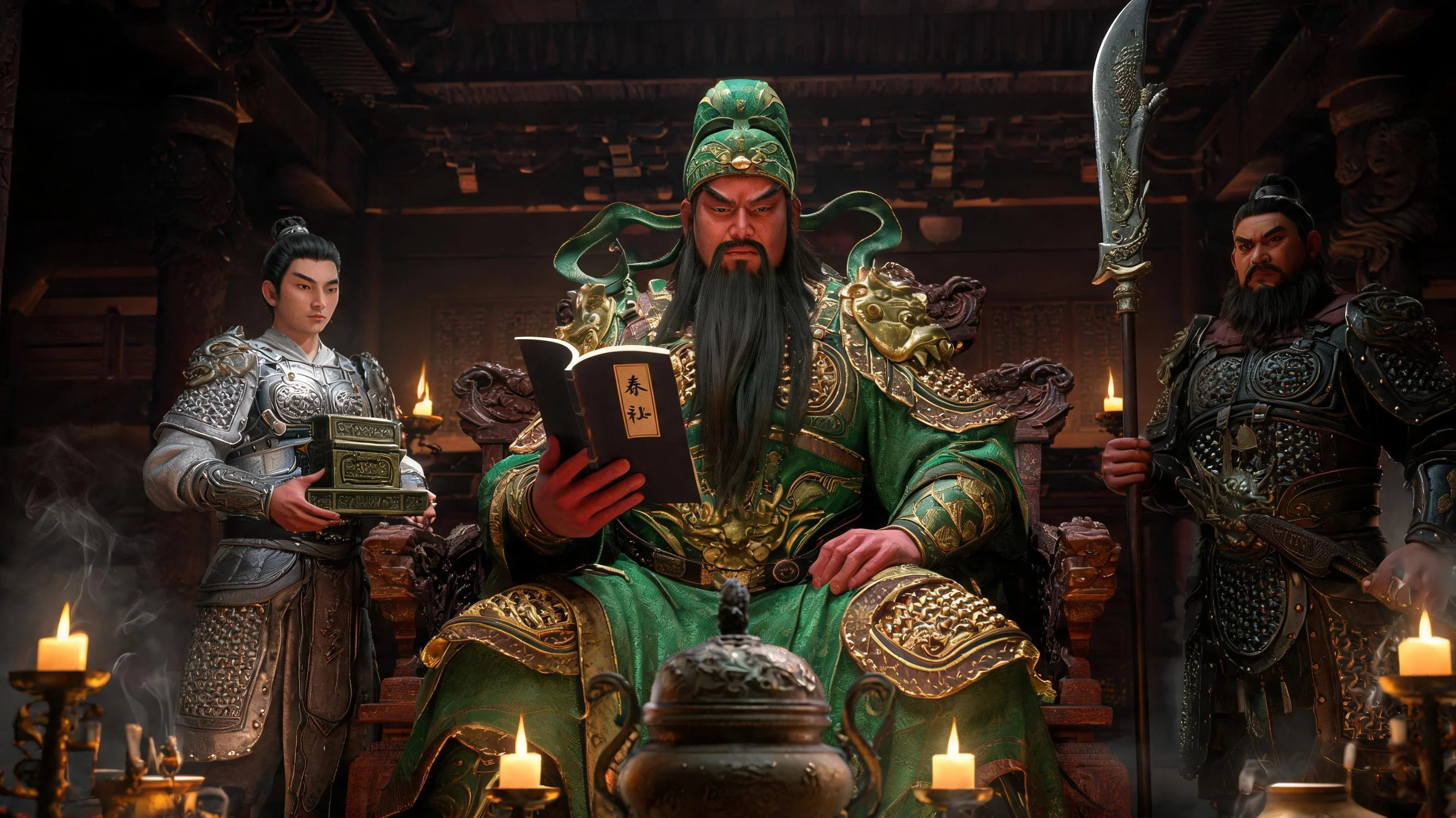
Sangharama Bodhisattva (Qielan)
伽蓝菩萨 · 伽藍菩薩
Dharma-Protecting Sangharama Bodhisattva (in the form of Guan Yu)
Divine Office
- Guarding monastic compounds and ensuring peace and tranquillity within temples
- Protecting monastics in their cultivation and repelling demonic interference from without
- Overseeing temple affairs and safeguarding monastic property and resources
- Upholding the Dharma through loyalty and righteousness, thereby intimidating those who show disrespect
Origin & Legend
‘Jialan’ is the abbreviated Chinese transliteration of the Sanskrit term ‘sanghārāma’, meaning ‘monastic garden’—a compound where monastics reside. Deities entrusted with protecting such monastic precincts are known as Sangharama Bodhisattvas. In early Chinese Buddhism, eighteen dharmapāla deities were commonly enshrined as Jialan gods. From the Song dynasty onward, however, the legend that the Tiantai patriarch Zhiyi had converted Guan Yu into a Buddhist protector gained widespread acceptance. Consequently, Guan Yu became the principal deity enshrined in the Sangharama Hall of Han Chinese Buddhist temples, standing alongside Skanda Bodhisattva (Weituo Pusa) as one of the two great Dharma protectors—one guarding the mountain gate, the other the monastic compound. The 13th day of the 5th lunar month—the day traditionally observed as Guan Yu’s ‘Sword-Sharpening Day’—is also celebrated as the birthday of the Sangharama Bodhisattva; on this day, Buddhist communities hold sutra-recitation ceremonies in commemoration. Revered jointly by Confucianism, Buddhism, and Daoism, Guan Yu exemplifies the profound syncretism characteristic of Chinese religious culture.
 Children & Marriage
 Safety & Blessing
 Safety & Blessing
 Health & Averting Calamity
 Studies & Exams
 Safety & Blessing
 Safety & Blessing
 Health & Averting Calamity