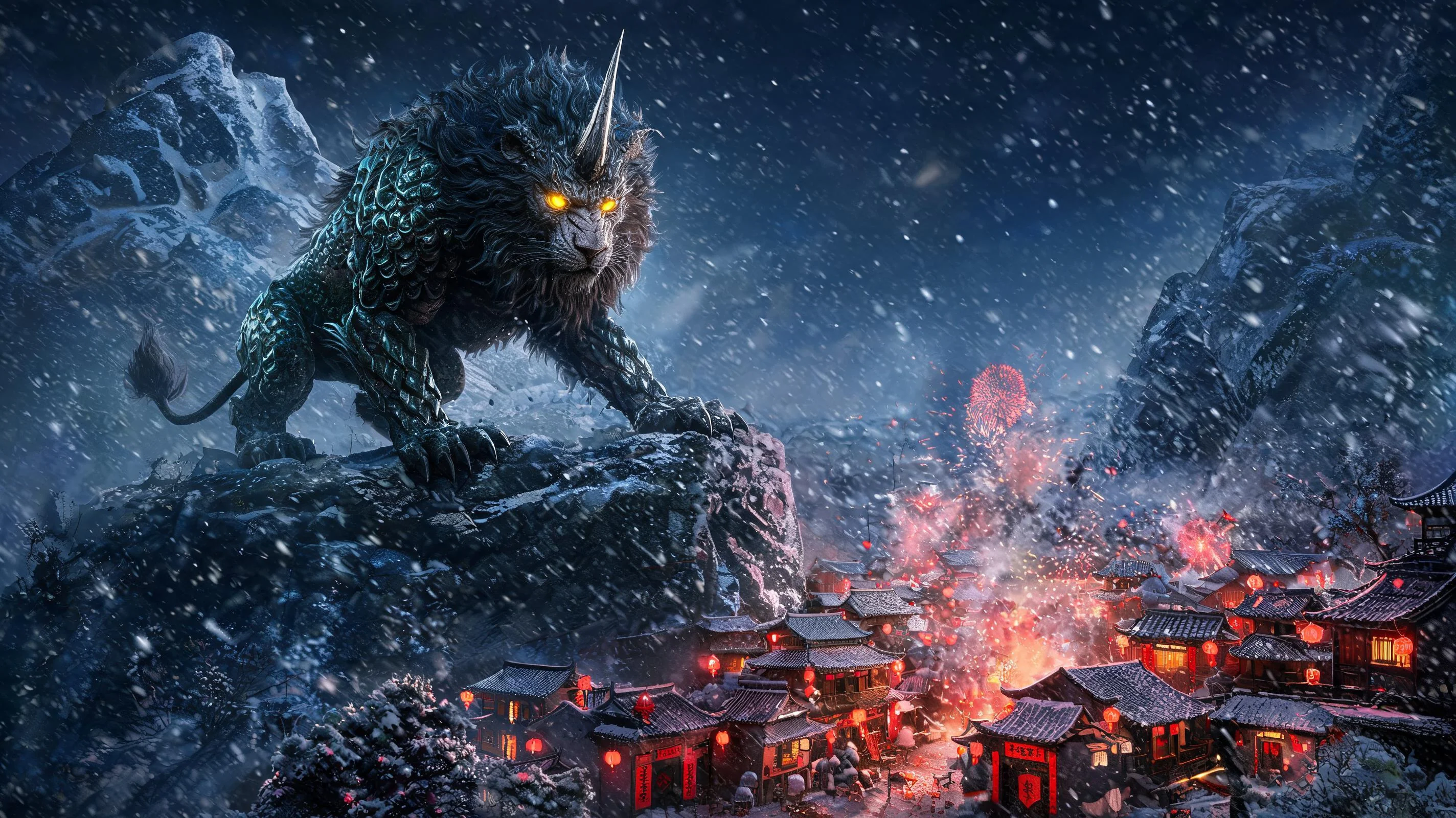
Nian Beast
年兽 · 年獸
The Malevolent Nian at Year’s End
Divine Office
- Appears at the turn of the year—between the last day of the old year and the first day of the new
- Is driven away by red decorations, firecrackers, and blazing light
- Serves as a cautionary impetus for the custom of staying awake to guard the household on New Year’s Eve
- Paradoxically becomes the origin of New Year folk customs
Origin & Legend
The Nian Beast lies at the heart of popular narratives explaining the origins of the Spring Festival. Legend holds that in ancient times, this ferocious creature would descend upon villages at year’s end, devouring livestock and people alike, forcing families to barricade themselves indoors or flee. Eventually, villagers discovered that the Nian Beast feared three things: the colour red, bright light, and deafening sounds. On Chinese New Year’s Eve, they therefore pasted red couplets, lit firecrackers, illuminated their homes with candles and lanterns, and stayed awake all night to ward it off—and the beast indeed dared not approach. Though the Nian Beast appears in no classical Chinese texts and was only codified as a cohesive folk narrative in modern times, it offers a compelling, widely embraced explanation for enduring Spring Festival traditions—including pasting spring couplets, setting off firecrackers, and the custom of staying awake to welcome the new year. Today, it is an indispensable symbol within Chinese New Year cultural iconography, embodying both a mythic menace and a foundational folkloric landmark.
 Wealth
 Safety & Blessing
 Wealth
 Safety & Blessing
 Studies & Exams
 Wealth
 Children & Marriage
 Wealth