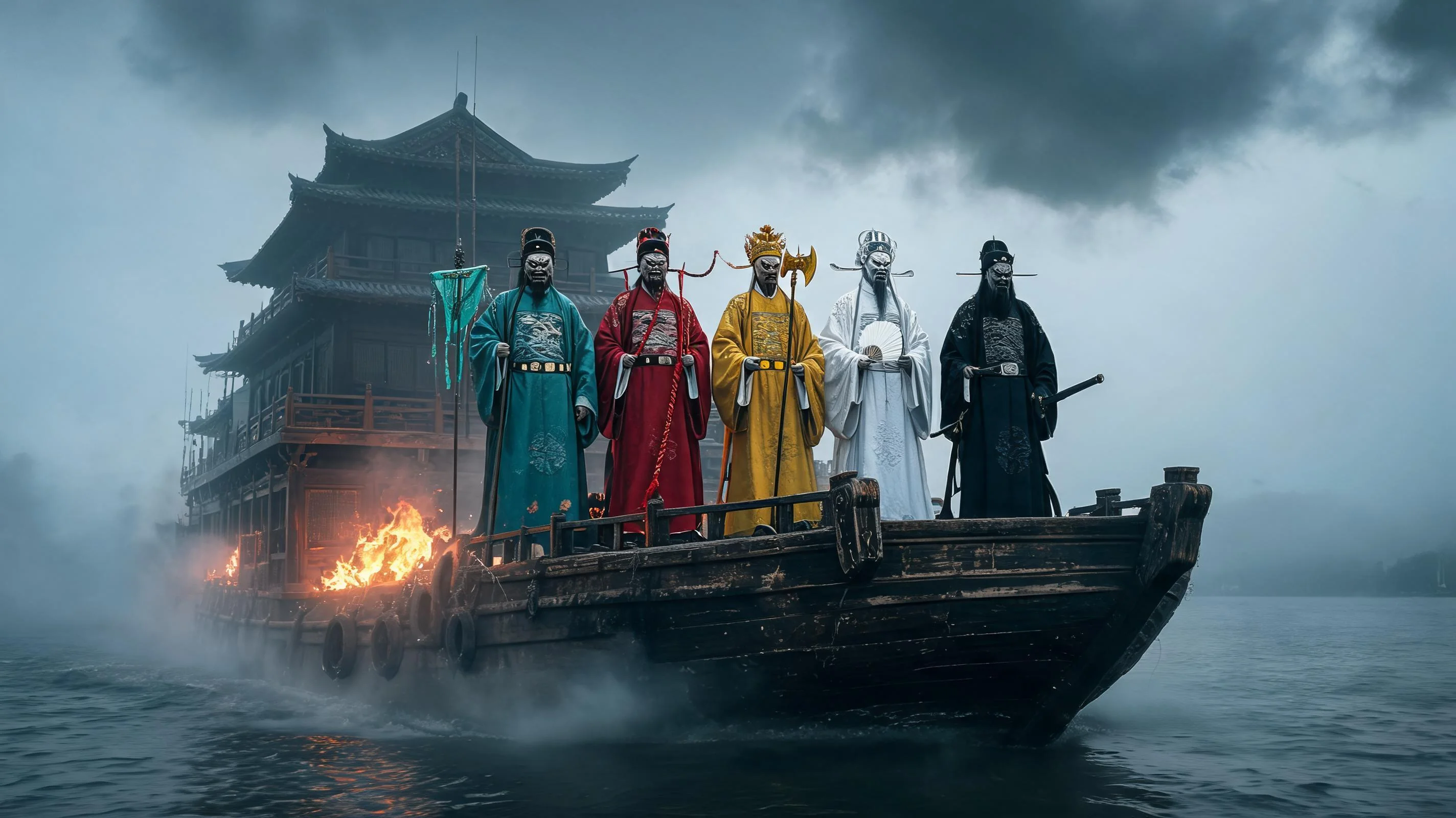
Five Plague Gods
瘟神 · 瘟神
Wu Wen Shizhe (the Five Plague Messengers: Zhang Yuanbo, the Spring Plague God; Liu Yuanda, the Summer Plague God; Zhao Gongming, the Autumn Plague God; Zhong Shigui, the Winter Plague God; and Shi Wenyi, the Central Plague God)
Divine Office
- Governing plague epidemics across the five cardinal directions and overseeing their outbreak and cessation
- Patrolling the human realm to inspect moral conduct and disseminating plague as punishment for evil deeds
- Receiving ritual offerings and appeasement to drive away plagues and expel pestilence, thereby safeguarding local communities
- Deities venerated in rituals such as the Dragon Boat Festival’s ‘Plague-Expelling Boat’ ceremony
Origin & Legend
Belief in the Plague Gods originated in ancient China’s fear of epidemic disease and efforts to avert it. According to a legend from the Sui dynasty, Emperor Wen dreamed of five mighty warriors; his court astrologer interpreted them as the Five Plague Gods, dispatched by the Celestial Emperor to inspect human conduct on earth. The emperor consequently established shrines in their honour, and the names of the Five Plague Messengers—Zhang Yuanbo, Liu Yuanda, Zhao Gongming, Zhong Shigui, and Shi Wenyi—entered enduring tradition. Intriguingly, Zhao Gongming later abandoned his role as a plague deity and transformed into the renowned God of Wealth. In premodern Jiangnan, Fujian, and Guangdong—regions frequently afflicted by epidemics—communities either erected temples to worship the Plague Gods or held Dragon Boat Festival ceremonies in which paper boats symbolising pestilential qi were burned and set adrift, beseeching the Five Plague Messengers to gather up and contain toxic influences, thus ensuring local well-being.
 Wealth
 Safety & Blessing
 Wealth
 Safety & Blessing
 Studies & Exams
 Wealth
 Children & Marriage
 Wealth