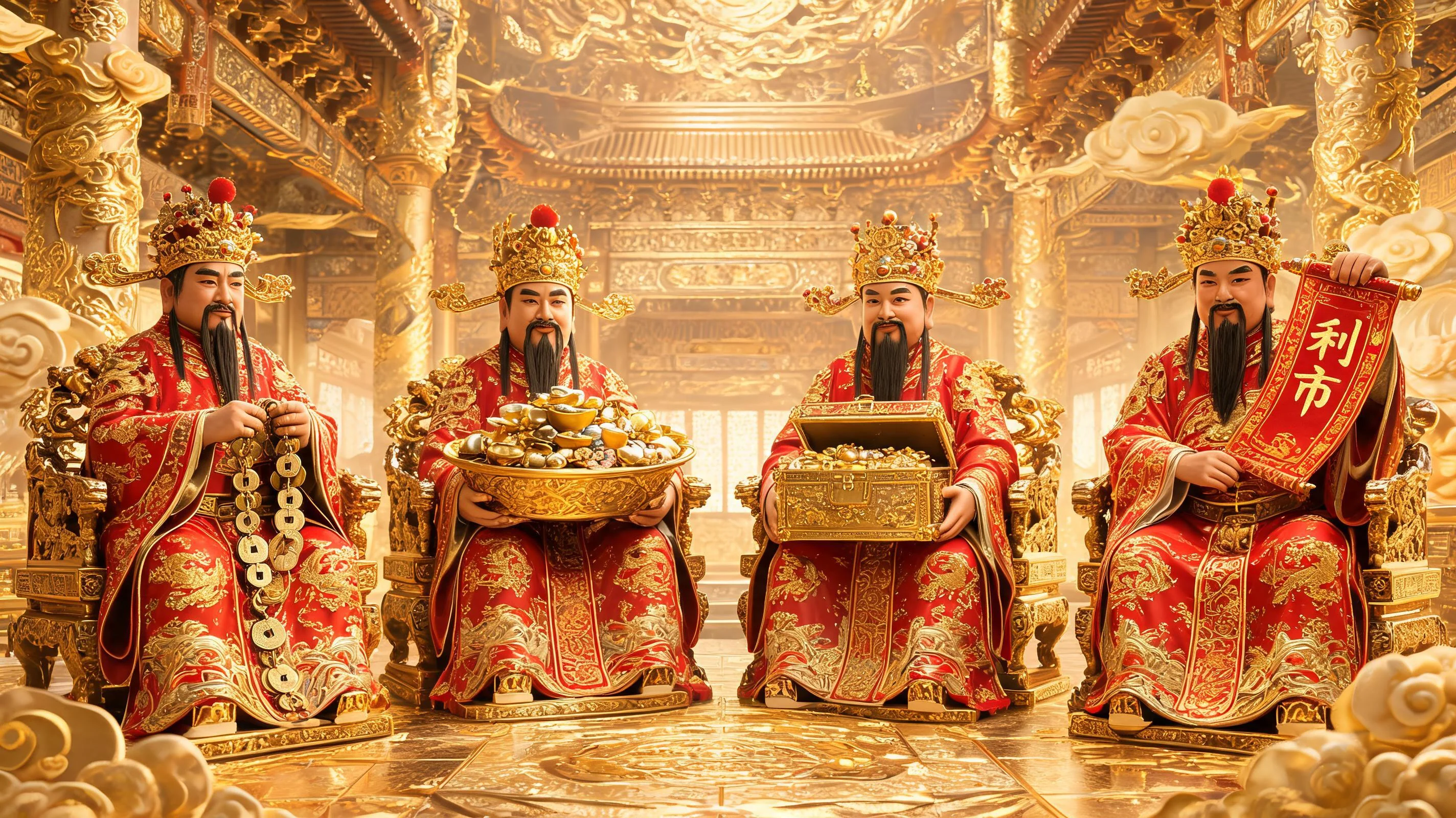
Silu Caishen (Four Gods of Wealth)
四路财神 · 四路財神
Zhaobao, Nazhen, Zhaochai, and Lishi—the Four Gods of Wealth
Divine Office
- Governing wealth sources in the four cardinal directions
- Attracting treasures and precious goods, drawing in wealth
- Blessing commerce across all five routes
- Welcoming auspiciousness and delivering treasures during the New Year
Origin & Legend
The Silu Caishen are subordinate deities of wealth who originated as four generals under Zhao Gongming in the Ming-dynasty novel Fengshen Yanyi (Investiture of the Gods) and were later enfeoffed as minor wealth deities: Zhaobao Tianzun (Heavenly Lord of Treasure Attraction) Xiao Sheng, Nazhen Tianzun (Heavenly Lord of Precious Goods Reception) Cao Bao, Zhaochai Shizhe (Envoy of Wealth Attraction) Chen Jiugong, and Lishi Xianguan (Immortal Official of Prosperity) Yao Shaosi. Each governs one of four specific functions—treasure attraction, reception of precious goods, wealth acquisition, and commercial prosperity—and collectively, together with the Central God of Wealth Zhao Gongming, form the Wulu Caishen (Five Gods of Wealth), presiding over wealth sources in the five directions: east, south, west, north, and center. In traditional merchant practice, the fifth day of the first lunar month—the ‘Welcoming of the Caishen’—entailed inviting all five deities simultaneously, symbolizing the simultaneous influx of wealth from all five routes. Shop altars commonly bore inscriptions such as ‘May the Wealth-Attracting Boy arrive’ and ‘May the Prosperity Official come’. Though typically enshrined in smaller side niches, the Four Gods of Wealth, alongside principal wealth deities like Guan Yu (God of War and Wealth) and Zhao Gongming, constitute the most comprehensive system of wealth veneration in Chinese folk religion.
 Wealth
 Safety & Blessing
 Wealth
 Safety & Blessing
 Studies & Exams
 Wealth
 Children & Marriage
 Wealth