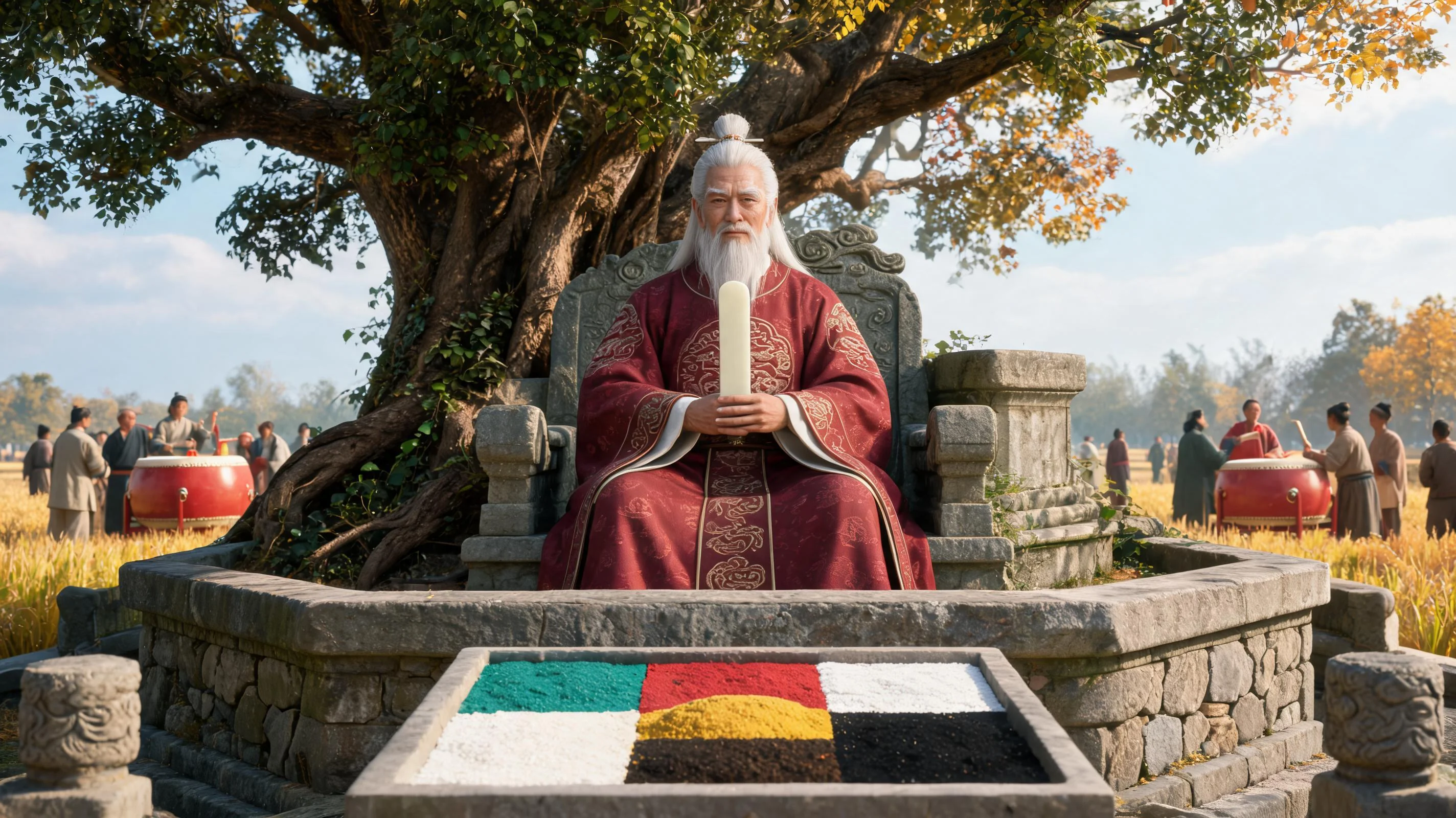
She Shen (God of Land)
社神 · 社神
Divine Sovereign of the Grand She Altar; Consort and Consort of the Communal She Altar
Divine Office
- Govern a designated region of land
- Oversee agricultural abundance or scarcity
- Receive sacrificial offerings during the spring and autumn rites
- Safeguard the peace and security of local communities
Origin & Legend
She Shen—the 'She' in Sheji—embodies the divine personification of land itself, rooted in ancient veneration of earth as life-giving and sacred. The character 'she' originally denoted a site dedicated to earth worship. Under Zhou-dynasty regulations, one communal She altar was established for every twenty-five households; the Spring She rite petitioned for bountiful harvests, while the Autumn She rite gave thanks for the completed harvest—rituals that endured for over two millennia as major state and folk observances. The Sheji Altar in Beijing’s Zhongshan Park, with its square platform of five-coloured soil, preserves the Ming and Qing imperial tradition of worshipping the Grand She. Distinct from Tudigong—the grassroots tutelary deity of individual villages or neighbourhoods—She Shen governs an entire territorial domain, presides over agricultural prosperity or failure, and ensures communal safety and stability. In former times, village-level She festivals featured lively processions, communal feasting on She wine and She rice, and vibrant public celebrations—the very spectacle evoked in Wang Anshi’s poem, where ‘flutes and drums follow close upon Spring She Day.’
 Wealth
 Safety & Blessing
 Wealth
 Safety & Blessing
 Studies & Exams
 Wealth
 Children & Marriage
 Wealth