
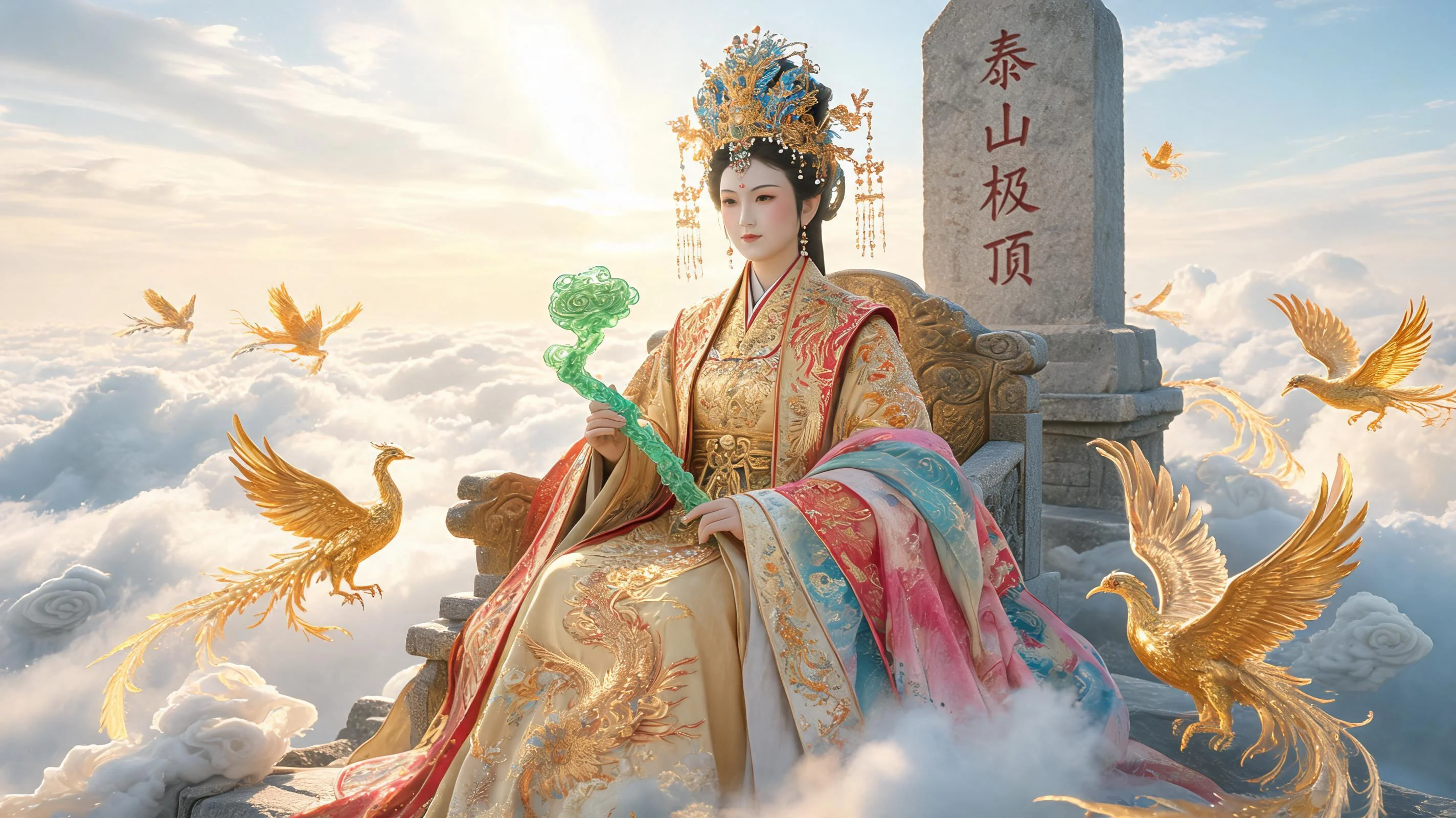
Mystic Queen of the Nine Heavens
九天玄女 · 九天玄女
Jiutian Xuannü Yuánjūn (Primordial Sovereign Mystic Queen of the Nine Heavens)
Divine Office
- Imparting military strategy and statecraft to aid righteous warfare and suppress tyranny while ensuring justice and peace
- Guarding celestial scriptures and esoteric registers, bestowing the arts of Qi Men Dun Jia (a divinatory system integrating astronomy, astrology, and strategic calculation)
- Protecting armies upholding justice and endowing their leaders with wisdom and tactical insight
- Blessing scholarly pursuits and intellectual development, and safeguarding women and children
Origin & Legend
Jiutian Xuannü—commonly known as Xuannü—is a renowned ancient Chinese goddess of war and wisdom. Legend holds that when the Yellow Emperor struggled for an extended period to defeat the rebel leader Chi You, Xuannü descended at the behest of the Queen Mother of the West (Xiwangmu) and bestowed upon him the Six Jia and Six Ren talismans of military authority, profound treatises on statecraft and battlefield strategy, and the arcane techniques of Qi Men Dun Jia—enabling his decisive victory over Chi You at Zhuolu. Thereafter, successive rulers launching just wars frequently claimed divine commission from Xuannü: Song Jiang of the Song dynasty was said to have received her celestial scripture, and Liu Bowen, the Ming-dynasty strategist, was likewise believed to have received her guidance. In Daoism, she is venerated as Jiutian Xuannü Yuánjūn and revered as an ancient female immortal and a supremely exalted goddess. Because she governs celestial scriptures and strategic wisdom, scholars and students traditionally worship her for academic success and intellectual enlightenment; in popular belief, she is also regarded as a compassionate protector of justice and a rescuer of those in peril, and temples dedicated to her—especially in the provinces of Shanxi, Hebei, Shandong, and Henan—continue to draw steady streams of devotees.
 Safety & Blessing
 Safety & Blessing
 Health & Averting Calamity
 Studies & Exams
 Children & Marriage
 Warding Off Evil
 Safety & Blessing
 Children & Marriage