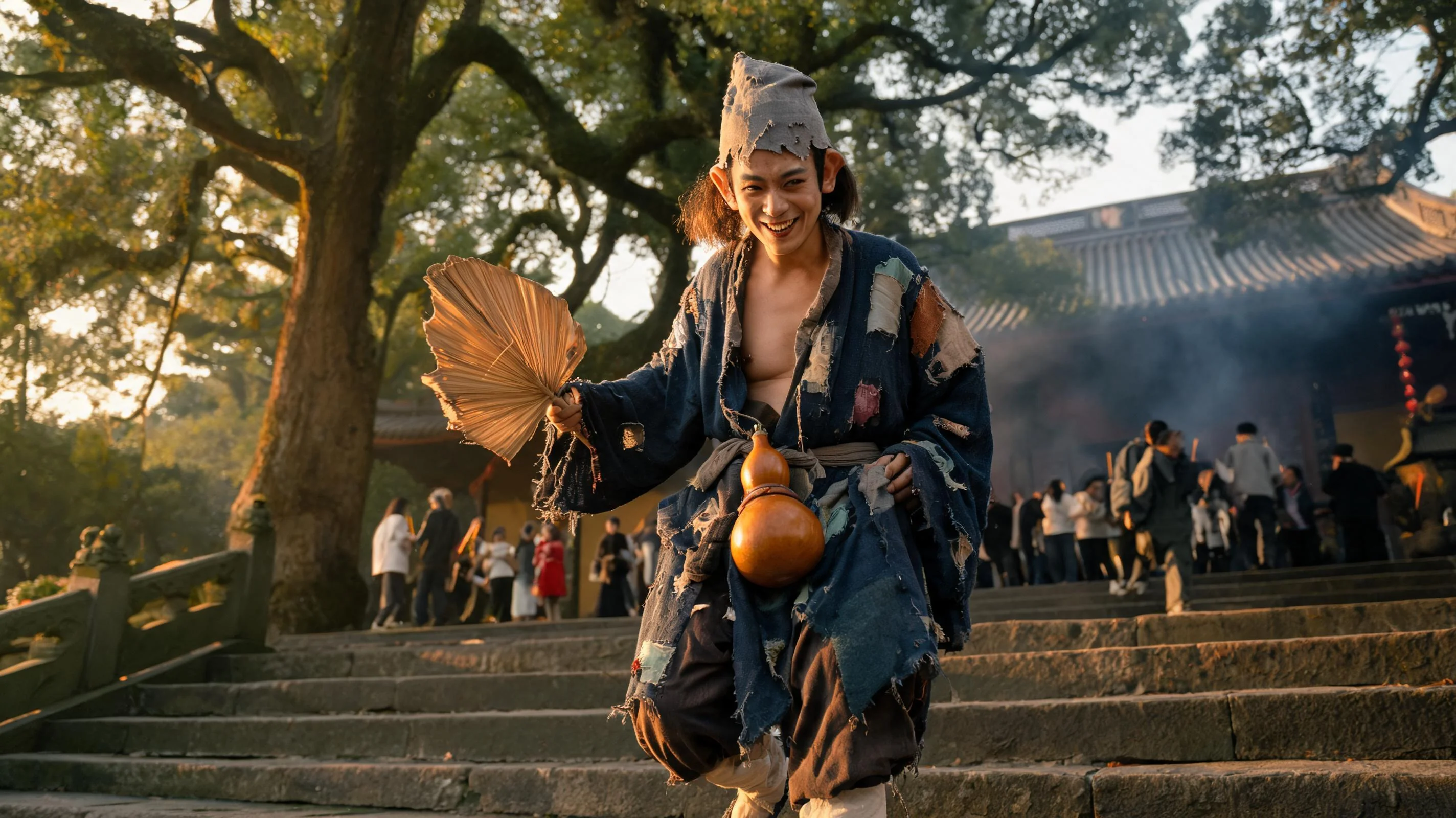
Ji Gong (The Mad Monk)
济公 · 濟公
Greatly Compassionate, Greatly Benevolent, Greatly Virtuous, and Supreme Golden Arhat Venerable Anuo, Living Buddha Ji Gong
Divine Office
- Alleviating suffering and aiding the world with compassion
- Possessing exceptional medical skills to heal the common people of their illnesses and ailments
- Mocking the powerful and privileged while rescuing the vulnerable and upholding justice
- Wielding vast supernatural powers to subdue demons and vanquish evil, thereby relieving the people’s distress and hardship
Origin & Legend
Ji Gong’s secular name was Li Xiuyuan; he was a native of Tiantai County, Taizhou Prefecture, Zhejiang Province, during the Southern Song Dynasty. He became a monk at Lingyin Temple in Hangzhou, receiving the Dharma name Daoji. Unbound by monastic precepts, he indulged freely in wine and meat and behaved in ways deemed eccentric—but he mastered medicine, delighted in charitable acts, rescued those in peril, aided the destitute, and punished evildoers. The people reverently addressed him as ‘Living Buddha Ji Gong’. Folklore preserves legendary tales such as ‘transporting timber via an ancient well’ and ‘saving lives atop Feilai Peak’. His fame spread widely through the Qing-dynasty novel *Complete Biography of Ji Gong*, which cemented his household-name status. Precisely because he disregarded formal appearances while harbouring boundless compassion, he perfectly embodied the folk ideal of the chivalrous, mad monk—prompting temples dedicated to Ji Gong across China. His ancestral home in Yongning Village, Tiantai Mountain, and the Ji Gong Hall at Lingyin Temple continue to draw steady streams of devotees and incense offerings.
 Wealth
 Safety & Blessing
 Wealth
 Safety & Blessing
 Studies & Exams
 Wealth
 Children & Marriage
 Wealth