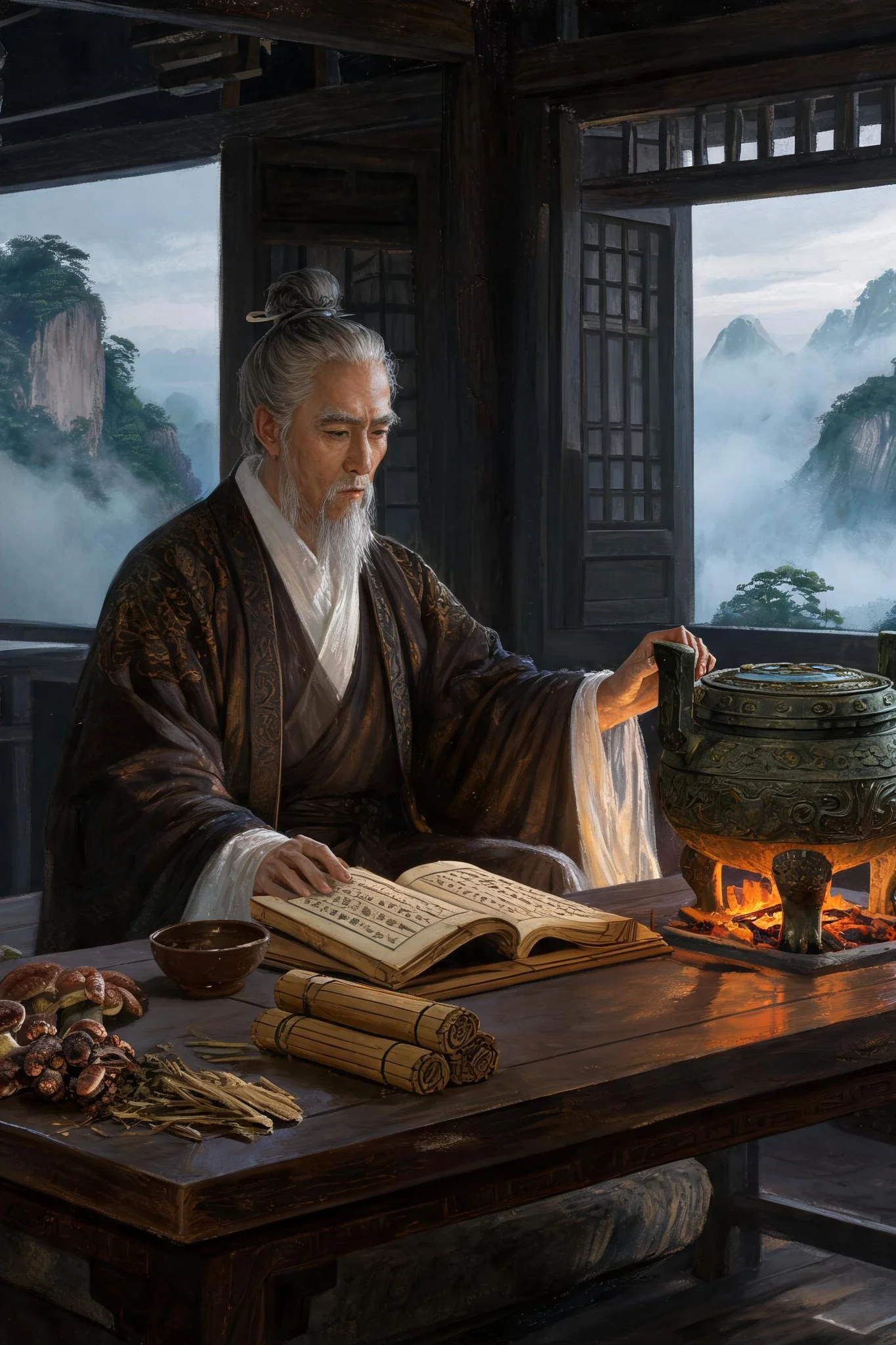
AI-generated likeness
Daoist Deities
Ge Hong
葛洪 · 葛洪
Baopuzi (The Master Who Embraces Simplicity), Xiao Xianweng (Little Immortal Elder), and Grand Master of Alchemy and Traditional Medicine
Divine Office
- Authored the Baopuzi to expound and propagate Daoist immortality teachings
- Practised alchemical cultivation and pursued the arts of longevity
- Authored the Zhubei Jiyu Fang (Handbook of Prescriptions for Emergencies) to aid and heal the suffering populace
- Founded the Daoist monastic center at Luofu Mountain in Lingnan
Origin & Legend
Ge Hong, styled Zhichuan and self-styled Baopuzi (The Master Who Embraces Simplicity), was a native of Jurong in Danyang Commandery during the Eastern Jin dynasty and the grandnephew of the Daoist master Ge Xuan. From youth he cultivated a deep fascination with immortality practices and techniques of spiritual nourishment, studying alchemical scriptures and methods under the master Zheng Yin. Later, having heard that cinnabar—the essential ingredient for alchemical elixirs—was mined in Jiaozhi (modern northern Vietnam), he travelled south with his sons and nephews to Guangzhou and settled permanently on Luofu Mountain to refine elixirs and compose his seminal works. His magnum opus, the Baopuzi, synthesises and systematises the entire corpus of Han and Wei dynasty immortality doctrines; his Zhubei Jiyu Fang (Handbook of Prescriptions for Emergencies) records the use of qinghao (Artemisia annua) for treating malaria—a discovery that, over a millennium later, inspired Tu Youyou’s Nobel Prize–winning isolation of artemisinin. Ge Hong also provided the earliest known clinical descriptions of smallpox and other infectious diseases, earning him recognition as a pioneer of preventive medicine. In the Northern Song dynasty, he was posthumously enfeoffed as the Chongying Zhenren (Perfected One of Reverent Response), and the Chongxu Ancient Temple on Luofu Mountain remains an active center of Daoist worship to this day.
 Safety & Blessing
 Safety & Blessing
 Health & Averting Calamity
 Studies & Exams
 Children & Marriage
 Warding Off Evil
 Safety & Blessing
 Children & Marriage