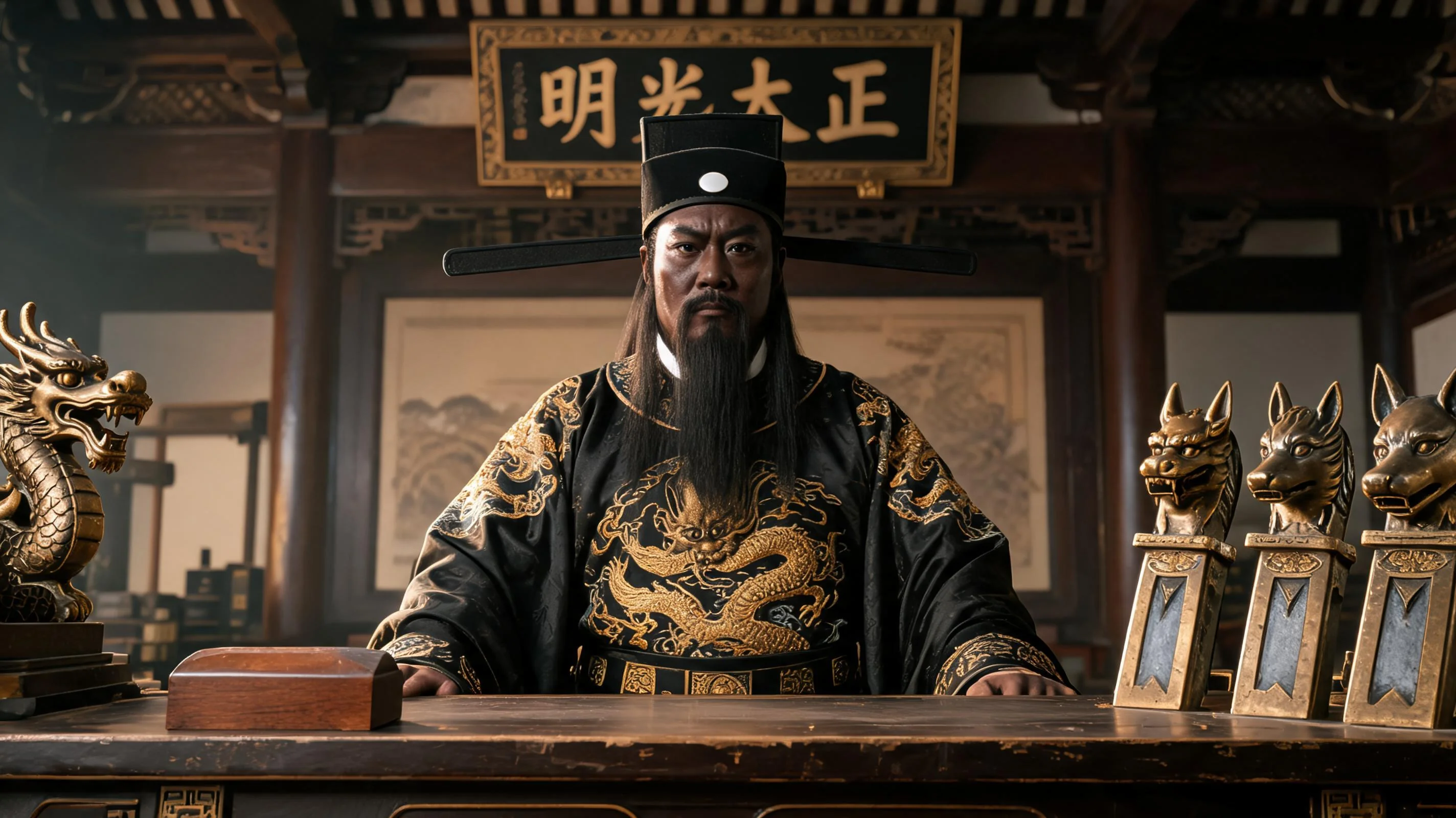
Bao Zheng
包拯 · 包拯
Lord Bao (Bao Qingtian, 'Lord Bao the Azure-Heavenly')
Divine Office
- adjudicating disputes with unerring fairness
- punishing corrupt officials and evil-doers
- safeguarding integrity, uprightness, and incorruptibility
- venerated by the common people as the earthly incarnation of the Fifth Hall Judge of the Ten Yama Kings (Yanluo Wang)
- exorcising malevolent spirits and protecting homes from harm
Origin & Legend
Bao Zheng (999–1062), a native of Luzhou (modern-day Hefei, Anhui Province) during the Northern Song Dynasty, rose to the high office of Vice Minister of Military Affairs (Shumishi). Renowned for his unwavering integrity, strict enforcement of law, and fearless defiance of powerful elites, he earned the epithet 'Bao Qingtian' ('Lord Bao the Azure-Heavenly'). His legendary impartiality gradually inspired folk deification, giving rise to tales of his dual jurisdiction: judging human affairs by day and presiding over the netherworld by night. From the Ming Dynasty onward, popular narratives elaborated that he entered the underworld via a 'spirit-traveling pillow' to adjudicate cases, and that after death he assumed the role of the Fifth Hall Judge among the Ten Yama Kings (Ten Courts of Hell), merging seamlessly with the traditional figure of Yanluo Wang. Temples dedicated to him stand at the Bao Gong Temple in Hefei, beside the Bao Gong Lake in Kaifeng, and at sites commemorating his administrative legacy in Zhaoqing. When wronged or unjustly treated, ordinary people traditionally pray to Lord Bao for redress, venerating him as the supreme deity of justice.
 Warding Off Evil
 Warding Off Evil
 Warding Off Evil
 Warding Off Evil
 Safety & Blessing
 Safety & Blessing
 Health & Averting Calamity
 Warding Off Evil