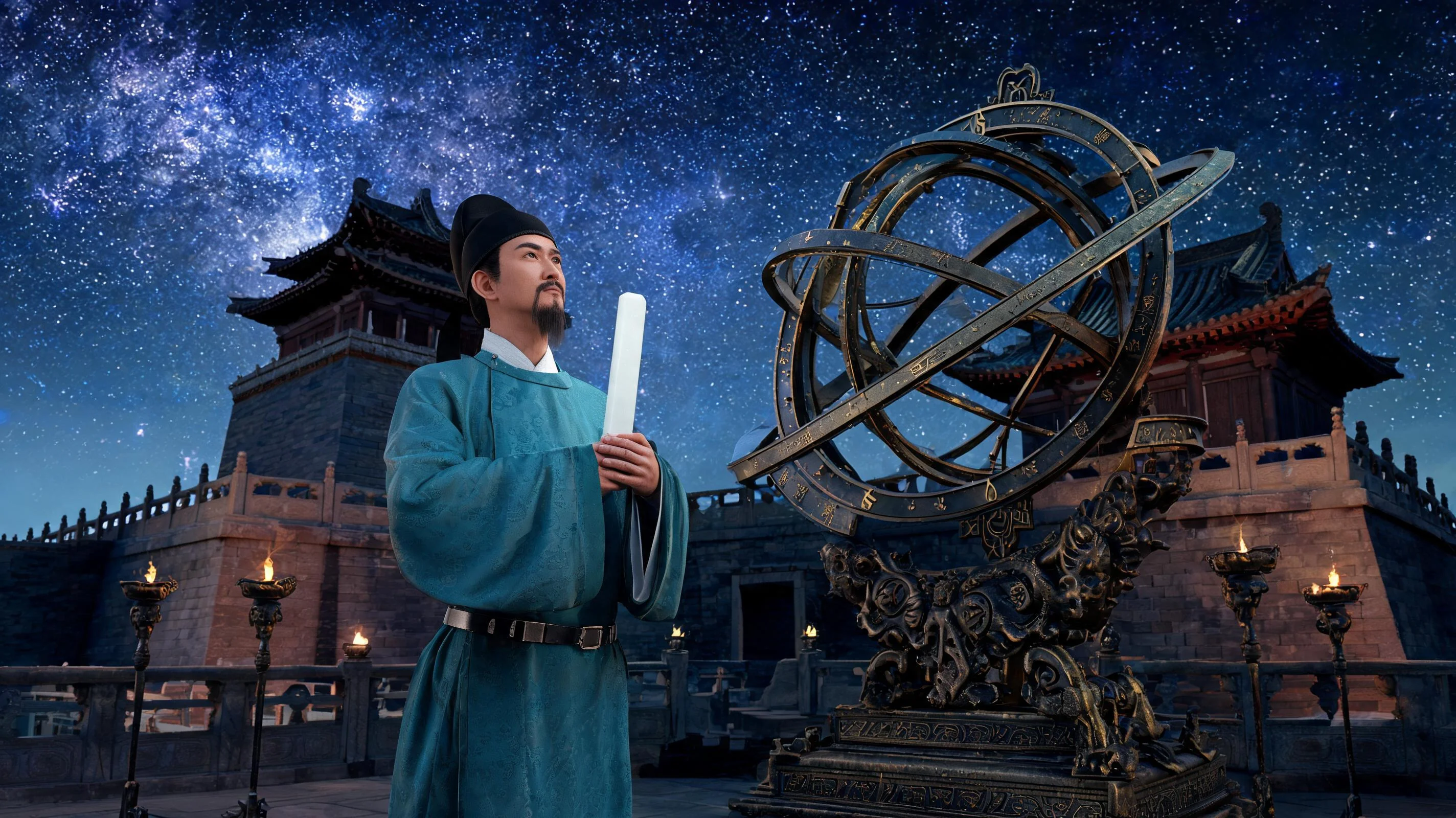
Li Chunfeng
李淳风 · 李淳風
Master Astronomer and Calendrical Scientist · Sage of Divination
Divine Office
- Protecting the scholarly study of astronomy and calendrical science
- Safeguarding celestial observation and meteorological forecasting
- Ensuring the accuracy of divinatory prognostication and omens
- Inspiring the study and refinement of calendrical systems
- Guarding bountiful harvests through harmonious winds and timely rains
Origin & Legend
Li Chunfeng was a native of Yong County, Qizhou Prefecture, during the Tang dynasty. From childhood, he immersed himself in classical learning and developed exceptional expertise in astronomy and calendrical mathematics. He served for decades in the Imperial Astronomical Bureau, where he redesigned the celestial globe into a three-tiered instrument, compiled the Linde Calendar, and annotated ten canonical mathematical texts—including the Zhou Bi Suan Jing (The Arithmetical Classic of the Gnomon and the Circular Paths of Heaven) and the Nine Chapters on the Mathematical Art—which became standard curricula at the Imperial College. His contributions to Chinese astronomy and mathematics were profound and enduring. He also authored the Yi Si Zhan (Divinatory Treatise of the Year Yi Si), one of the earliest specialized works on meteorology in world history, which introduced the first systematic wind-scale classification. Folk tradition holds that he co-authored the Tu Bei Tu (Thrusting-Back Diagrams)—a famed prophetic text forecasting dynastic rise and fall—with Yuan Tiangang; the two are said to have retired together to Langzhong, where they spent their final years. Subsequent generations of diviners, astrologers, and meteorological forecasters have venerated Li Chunfeng as their founding master.
 Studies & Exams
 Health & Averting Calamity
 Safety & Blessing
 Health & Averting Calamity
 Health & Averting Calamity
 Studies & Exams
 Safety & Blessing
 Studies & Exams