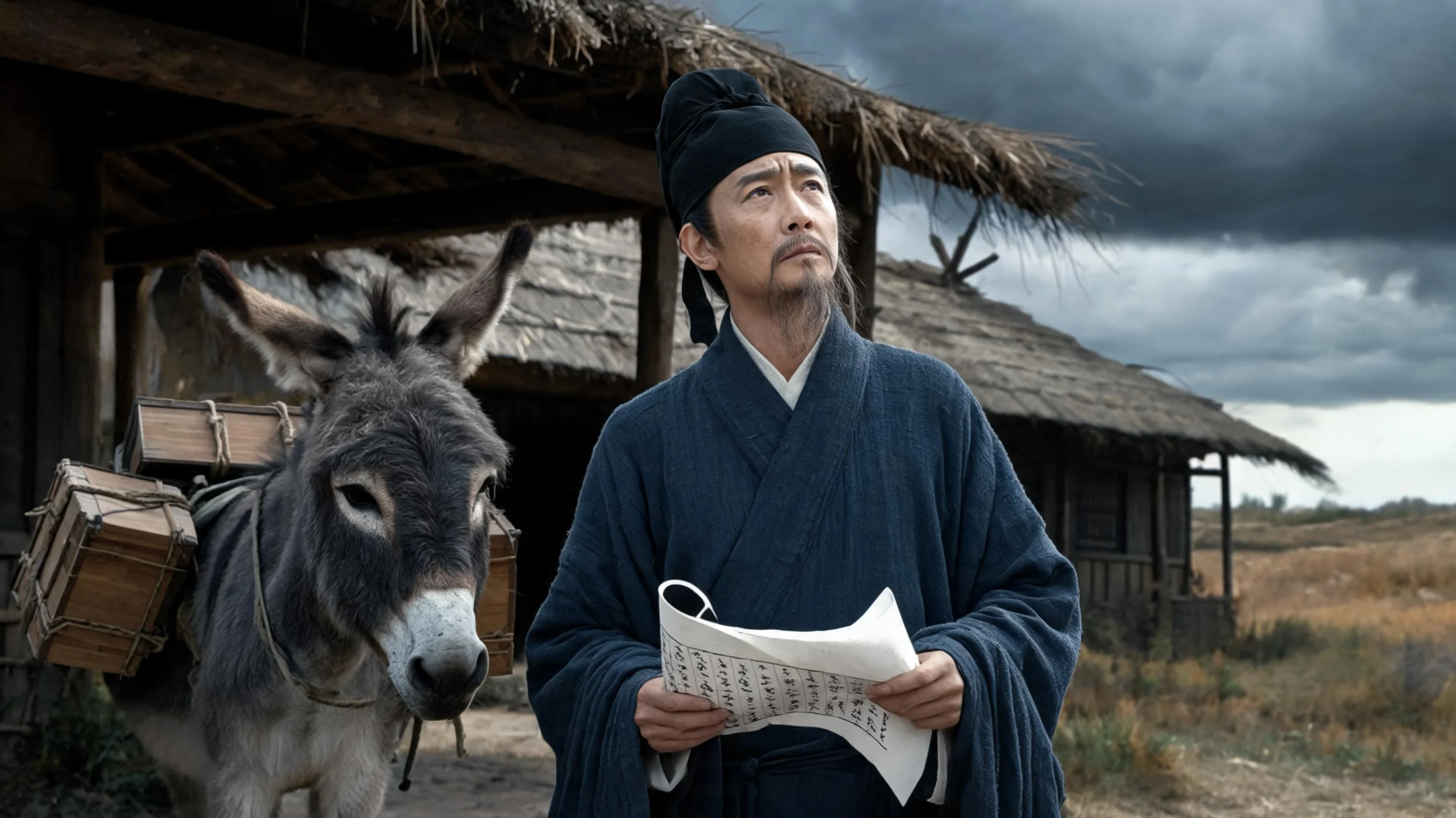
Du Fu
杜甫 · 杜甫
Sage of Poetry
Divine Office
- Blessing students with refined poetic skill and effortless literary composition
- Protecting literati in their devotion to national welfare and popular well-being
- Sheltering the transmission and flourishing of poetry, lyrics, and songs
- Overseeing the poetic path and literary lineage
Origin & Legend
Du Fu, styled Zimei and self-styled Shaoling Ye Lao (Hermit of Shaoling), was a native of Gongxian during the Tang dynasty and one of China’s greatest realist poets. His life spanned the cataclysmic An Lushan Rebellion, during which he endured exile, displacement, and firsthand experience of the people’s suffering—inspiring masterpieces such as the 'Three Officers' and 'Three Partings', and 'My Thatched Roof Swept Away by Autumn Gales', among over one thousand surviving poems collectively hailed as the 'Poetic History'. Deeply concerned for state and society, he wrote, 'All my life I worry for the common people; sighing, my bowels burn with fervent heat.' In his later years, he lived in poverty and ill health at the Thatched Cottage in Chengdu and later in Kuizhou, yet his poetic artistry matured ever further—marked by rigorous tonal discipline, somber depth, and rhythmic intensity—earning him the title Sage of Poetry. For over a millennium, his verses have drawn commentaries from countless scholars, giving rise to the literary phenomenon known as 'A Thousand Commentaries on Du Fu'. Students and poets venerate Du Fu, praying for unbroken continuity of the literary tradition and an inexhaustible spring of poetic inspiration.
 Studies & Exams
 Health & Averting Calamity
 Safety & Blessing
 Health & Averting Calamity
 Health & Averting Calamity
 Studies & Exams
 Safety & Blessing
 Studies & Exams