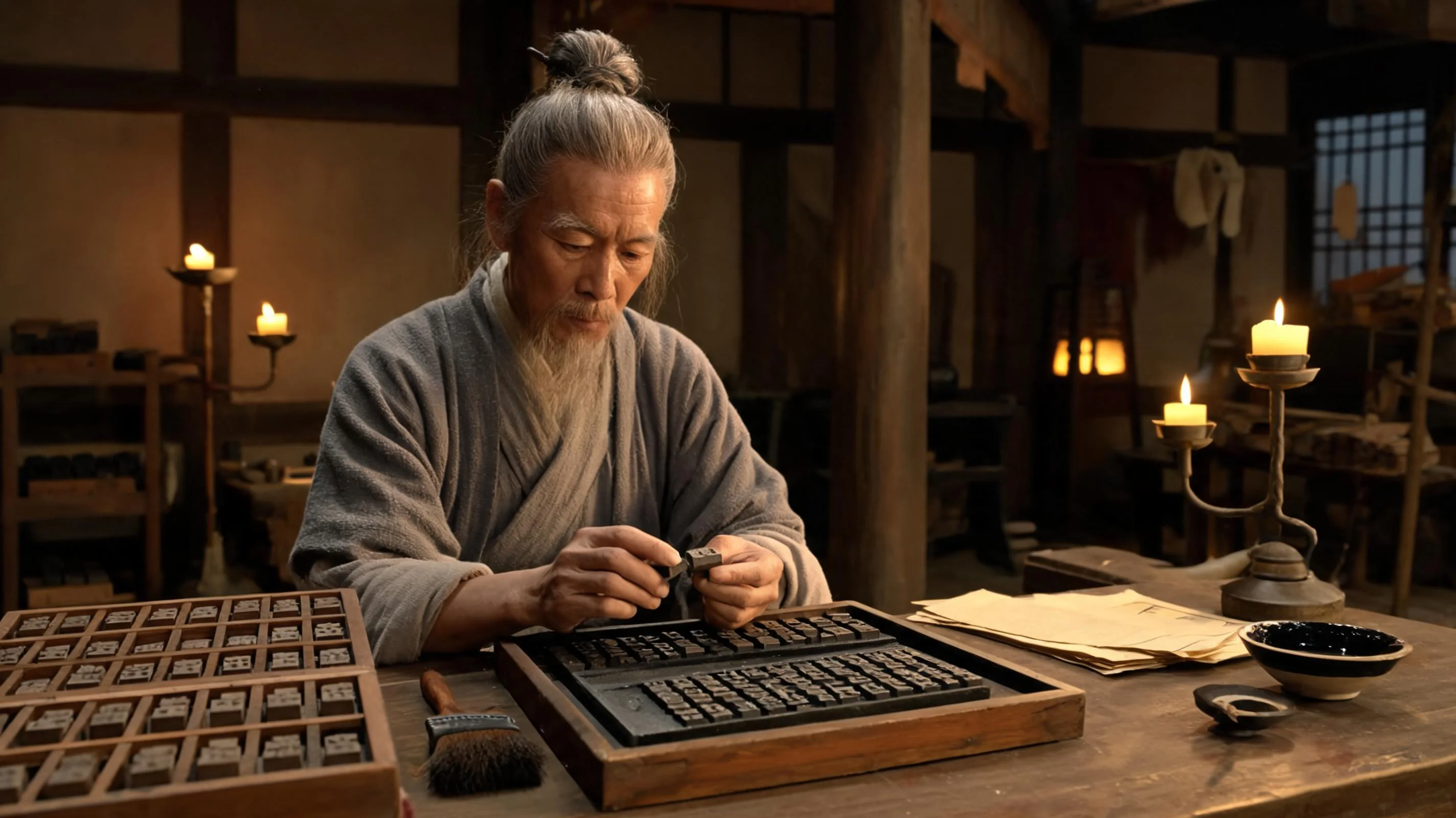
Bi Sheng
毕昇 · 畢昇
Inventor of Movable-Type Printing
Divine Office
- Safeguarding the prosperity and flourishing of the printing and publishing industry
- Ensuring typesetters accurately arrange and proofread characters without error
- Blessing the wide dissemination of books and the flourishing of literary fortune
- Overseeing the craft of printing
Origin & Legend
Bi Sheng, a commoner artisan from Qizhou in the Huainan Circuit during the Northern Song dynasty, invented movable-type printing during the Qingli era (1041–1048). He carved individual characters onto small clay blocks, hardened them by firing in a kiln, then arranged them on a frame for inking and printing. After each print run, the characters could be disassembled and reused—rendering the process both labour-saving and highly flexible, and dramatically increasing the efficiency of book production. His invention was recorded by Shen Kuo in the seminal scientific compendium Dream Pool Essays, securing its place in history as a watershed breakthrough in the annals of printing. It later spread to Korea, Japan, and Europe, profoundly advancing world civilisation; alongside Cai Lun’s invention of papermaking, it stands as one of the twin pillars of Chinese cultural innovation. Subsequent generations of printers and publishers have revered Bi Sheng as their patron deity, worshipping him to ensure every character shines with brilliance and literary fortune thrives. As an unranked commoner enshrined among the Four Great Inventions’ creators, Bi Sheng embodies the extraordinary ingenuity of ordinary people.
 Studies & Exams
 Health & Averting Calamity
 Safety & Blessing
 Health & Averting Calamity
 Health & Averting Calamity
 Studies & Exams
 Safety & Blessing
 Studies & Exams